
How Do Personal Injury Attorneys Win Multi-Million Dollar Verdicts?
Across the personal injury industry, attorneys have collectively recovered billions of dollars for injured clients over the years — from six-figure settlements to nine-figure trial verdicts. But most people never learn what actually separates a modest settlement from a life-changing one. It usually isn’t the injury alone. It’s how the case was built, and whether the attorney was ever actually prepared to take it to trial.
Quick Answer
The attorneys who win the largest verdicts share three habits: they investigate every case like it’s headed to trial, they document damages thoroughly, and they’re actually willing to file suit instead of settling for whatever an insurer first offers. About 96% of personal injury cases still settle before trial, but it’s that credible threat of trial that drives insurers to pay more. No attorney can guarantee a specific result — but asking whether a firm has a real trial track record is one of the best ways to judge how seriously your case will be handled.
The largest car-accident-related verdict in Texas history came out of Nueces County in 2021: a jury awarded $301 billion — $1.04 billion in actual damages and $300 billion in punitive damages — against a Corpus Christi bar found liable under Texas’s dram shop law after an over-served, heavily intoxicated customer caused a crash that killed a grandmother and her 16-year-old granddaughter in 2017. It remains one of the largest jury verdicts ever recorded in the United States. It’s also a reminder that a jury verdict and an actual recovery are two different things: the family’s own attorney said they never expected to collect the full amount, since the bar had already closed. (Houston Chronicle)
Big Verdicts Are Real — But They’re Not Random
Headlines about massive injury verdicts can make it seem like case value is a matter of luck: the right jury, the right judge, the right year. In reality, the attorneys who consistently produce large results — the kind reflected in real case results — tend to share the same handful of habits, regardless of the size of their firm.
1. They Investigate Like the Case Is Already Going to Trial
Evidence disappears fast. Surveillance footage gets overwritten, vehicles get repaired or scrapped, and witness memories fade. Attorneys who treat every case as a potential trial from day one send investigators immediately, preserve physical evidence, and lock in witness statements before they’re lost — long before any settlement conversation happens.
2. They Document Damages Thoroughly, Not Just Adequately
Insurance adjusters value a claim based on what can be proven, not what actually happened. Complete medical records, credible expert opinions, and clear documentation of how an injury affects daily life and future earning capacity all move a number — and gaps in that documentation are exactly what insurers look for to justify a lower offer.
3. They’re Willing to Actually File Suit
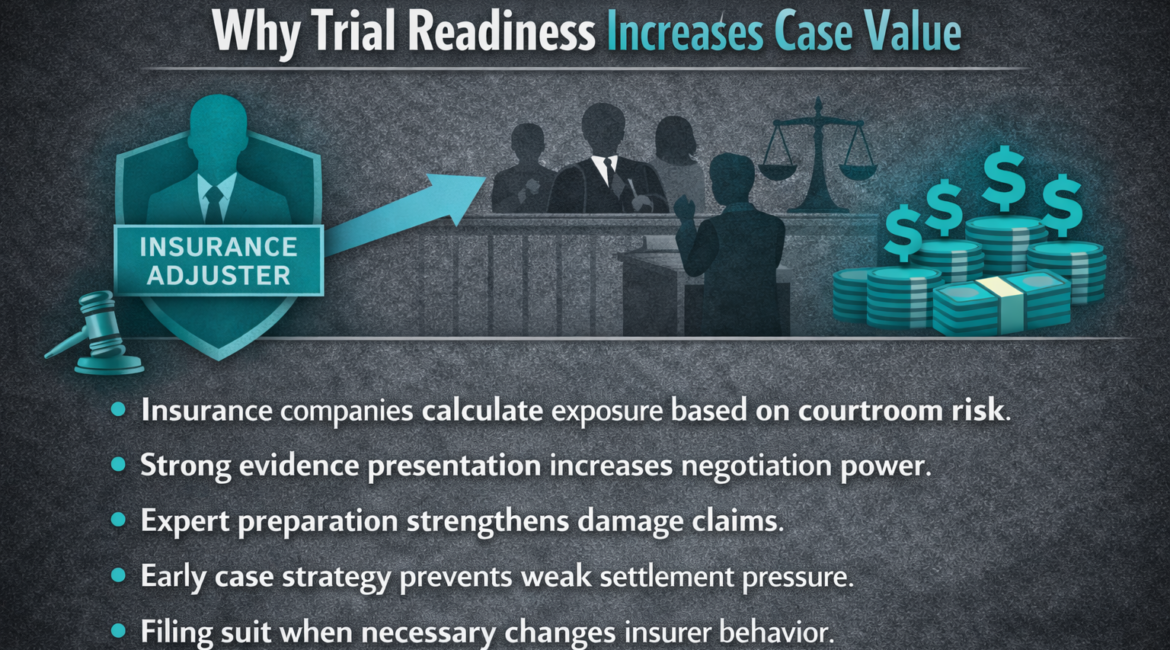
This is the one that matters most, and it’s the one that separates firms the most. An insurance company evaluates a claim differently once a lawsuit is filed and a firm has a track record of taking cases in front of a jury. A firm known for settling everything quickly, regardless of the offer, has little leverage to negotiate with — insurers know that firm will take whatever is offered rather than prepare for trial.
This is the core idea behind the distinction between a trial-ready firm and what’s sometimes called a settlement mill — a high-volume practice built around fast turnover rather than trial preparation. We wrote a full breakdown of the difference in our guide: Trial-Ready vs. Settlement Mill Law Firms in Texas. We’ve also written about what this looks like in practice in Trial-Ready Representation from The Texas Bulldog.
Why This Matters More Than the Size of the Injury
Two people can suffer nearly identical injuries in nearly identical crashes — whether a car accident or a commercial truck collision — and walk away with very different outcomes, not because one injury was worse, but because one case was prepared to go the distance and the other wasn’t. Insurance companies negotiate based on risk. A firm with a credible history of trial verdicts represents more risk to an insurer than a firm that has never taken a case past the settlement table, and that risk translates directly into higher offers.
That’s also why case value isn’t something a client can judge from the outside. The same set of facts can be worth very different amounts depending entirely on how the claim is built and who’s building it.
What This Means If You’re Evaluating an Attorney
Ask About Trial History
Not just settlements — how many cases has the firm actually taken to trial? A firm that can point to real trial verdicts has real leverage with insurers.
Ask Who Handles Your Case
High-volume firms often hand cases off to case managers with little attorney involvement until a settlement is ready to sign. Learn more about who’s actually on your case before you sign anything.
Watch the Pace
Pay attention to how quickly a firm pushes you toward a number. Wanting your signature before your medical treatment is even finished is a sign they’re optimizing for volume, not your outcome.
Frequently Asked Questions
Do most personal injury cases actually go to trial?
No. Roughly 96% of personal injury cases settle before trial, according to Bureau of Justice Statistics data. But the credible ability to take a case to trial is exactly what gives an attorney leverage to negotiate a higher settlement in the first place.
Does a more serious injury always mean a bigger settlement?
Not necessarily. Two people with similar injuries can receive very different outcomes depending on how thoroughly the case was investigated and documented, and whether the attorney handling it has a track record of taking cases to trial when necessary.
How can I tell if an attorney is actually trial-ready?
Ask how many cases the firm has actually taken to trial, not just settled, and ask who will personally handle your case. A firm with real trial verdicts and hands-on attorney involvement has genuine leverage; a firm that only settles does not.
Can an attorney guarantee what my case is worth?
No. Case value depends on the specific facts, the available insurance coverage, and the quality of the evidence, among other factors. Any attorney who guarantees a specific dollar amount before fully investigating your case should be treated with caution.
What’s the difference between a trial-ready firm and a settlement mill?
A trial-ready firm prepares every case as though it may go before a jury, which gives it leverage in negotiations. A settlement mill focuses on high case volume and quick turnover, often settling for whatever is offered rather than filing suit. Read more in our guide: Trial-Ready vs. Settlement Mill Law Firms in Texas.
Have Questions About What Your Case Might Be Worth?
Every case is different, and no attorney can promise a specific result. But you deserve a straight answer about how your case is being built and whether your attorney is actually prepared to fight for it. Contact The Miller Law Firm, home of The Texas Bulldog, for a free consultation.
Get a Free Case Review