
Texas Statute of Limitations Guide: How Long Do You Have to File a Personal Injury Lawsuit?
Last Reviewed: June 29, 2026
Reviewed By: Adam H. Miller, Texas Personal Injury Attorney
Reading Time: 12–15 Minutes
Practice Areas: Car Accidents • Truck Accidents • Motorcycle Accidents • Wrongful Death • Premises Liability • Personal Injury
Legal Sources: Texas Civil Practice & Remedies Code, Texas Rules of Civil Procedure, Texas court decisions, government agencies, and legal research.
Quick Answer
In most Texas personal injury cases, you have two years from the date of your injury to file a lawsuit. This legal deadline is known as the statute of limitations. If you fail to file your lawsuit before the applicable deadline expires, you may lose your right to seek compensation for medical bills, lost wages, pain and suffering, and other damages.
While the two-year rule applies to many cases—including car accidents, truck accidents, motorcycle crashes, slip and falls, and dog bites—there are important exceptions. The general two-year statute of limitations for most personal injury claims is established by Texas Civil Practice & Remedies Code § 16.003.Claims involving government entities often require notice within months, while cases involving minors, delayed discovery of an injury, or certain other circumstances may follow different rules.
This guide explains how the Texas statute of limitations works, when the filing deadline begins, common exceptions, and why acting quickly can help protect both your legal rights and critical evidence. Whether you were recently injured or you’re unsure how much time you have left, understanding these deadlines is one of the most important steps in protecting your claim.
Table of Contents
- What Is a Statute of Limitations?
- Why Texas Has Filing Deadlines
- The Two-Year Rule for Most Personal Injury Cases
- When Does the Filing Deadline Begin?
- Common Mistakes That Cause People to Miss the Deadline
- Important Exceptions to the Two-Year Rule
- Government Claims Have Much Shorter Deadlines
- Wrongful Death Filing Deadlines
- Can the Statute of Limitations Be Extended?
- Frequently Confused Legal Deadlines
- Why Waiting Can Hurt Your Case
- Real Texas Examples
- Myth vs. Fact
- Frequently Asked Deadline Scenarios
- Sources & References
What Is a Statute of Limitations?
A statute of limitations is a law that sets the deadline for filing a lawsuit. In Texas, most personal injury lawsuits are governed by Texas Civil Practice & Remedies Code § 16.003, which generally provides a two-year limitations period for personal injury claims.Every state has these deadlines, including Texas. If you file your lawsuit after the deadline expires, the court will usually dismiss your case, even if your injuries are serious.
For most Texas personal injury claims, the statute of limitations is two years. However, that deadline does not apply to every situation. Some claims have shorter deadlines, while others may qualify for limited exceptions.
Statutes of limitations serve an important purpose. Over time, evidence can disappear, witnesses may move away, and memories become less reliable. Filing deadlines encourage claims to be resolved while the evidence is still available.
Did You Know?
The statute of limitations generally applies to lawsuits—not insurance claims. Even if settlement negotiations are ongoing, you may still need to file a lawsuit before the deadline expires to protect your rights.
Why Texas Has Filing Deadlines
Many people wonder why there is a deadline for filing a lawsuit. The answer is simple: lawsuits are easier to investigate when the evidence is still fresh.
As time passes, important evidence can disappear. Witnesses may forget details, surveillance footage may be deleted, and damaged vehicles may be repaired or destroyed. Filing deadlines encourage people to bring claims while the facts are still available.
Texas courts recognize that timely lawsuits help create a fair process for everyone involved. Statutes of limitations also provide certainty by preventing legal disputes from remaining unresolved for many years.
Why Filing Deadlines Matter
- Witness memories become less reliable over time.
- Security camera footage is often automatically deleted.
- Vehicles may be repaired, sold, or scrapped.
- Electronic evidence can be lost.
- Businesses may no longer keep important records.
- Insurance companies become harder to challenge when evidence disappears.
Real-World Example
Imagine a crash at a busy Houston intersection. Nearby businesses may have surveillance cameras that captured the collision. Many systems automatically overwrite footage within days or weeks. If too much time passes, that valuable evidence may no longer exist—even though you still have time to file your lawsuit.
Key Takeaway
The two-year statute of limitations is the legal deadline to file most personal injury lawsuits in Texas. However, waiting until the last minute can make it much harder to prove your case because important evidence may disappear long before the deadline arrives.
The Two-Year Rule for Most Personal Injury Cases
- Car accidents
- Truck accidents
- Motorcycle accidents
- Pedestrian accidents
- Bicycle accidents
- Slip and fall accidents
- Dog bite injuries
- Many other negligence claims
Texas Personal Injury Deadlines at a Glance
| Type of Claim | Typical Deadline |
|---|---|
| Car Accident | 2 Years |
| Truck Accident | 2 Years |
| Motorcycle Accident | 2 Years |
| Slip and Fall | 2 Years |
| Dog Bite | 2 Years |
| Wrongful Death | Usually 2 Years |
| Government Claims | Often Much Shorter |
When Does the Filing Deadline Begin?
Knowing that you usually have two years to file a lawsuit is only part of the answer. You also need to know when the clock starts.
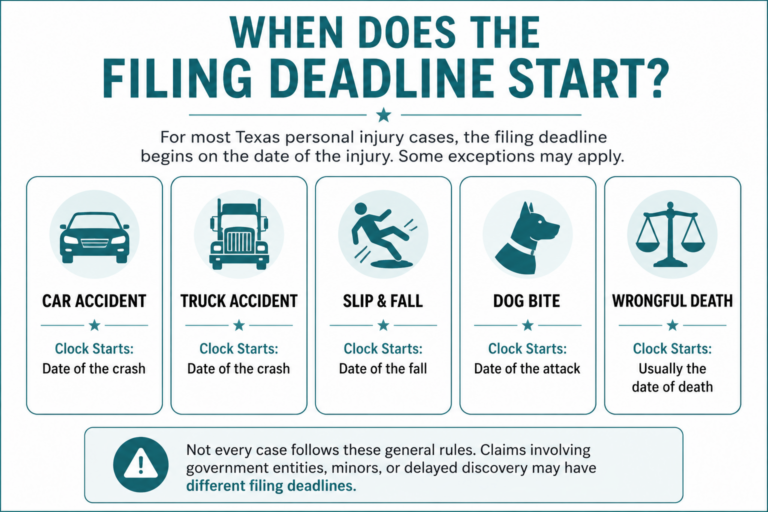
In many personal injury cases, the statute of limitations begins on the date the injury occurred. However, there are important exceptions. Some claims begin on a different date depending on the facts of the case.
When the Statute of Limitations Usually Begins
| Type of Case | When the Clock Usually Starts |
|---|---|
| Car Accident | Date of the crash |
| Truck Accident | Date of the crash |
| Slip and Fall | Date of the fall |
| Dog Bite | Date of the attack |
| Wrongful Death | Usually the date of death |
Not Every Case Is the Same
Although many cases follow these general rules, some claims have different deadlines. For example, injuries that are not discovered right away or claims involving government entities may follow different legal rules.
If you are unsure when your filing deadline began, it is best to speak with an attorney as soon as possible. Waiting too long could affect your legal rights.
Key Takeaway
For most Texas personal injury cases, the statute of limitations starts on the date of the injury. However, certain claims may follow different rules, making it important to understand the deadline that applies to your specific case.
Common Mistakes That Cause People to Miss the Deadline
Many people do not intentionally miss the statute of limitations. Instead, they make simple mistakes that delay their case until it is too late.
Understanding these common mistakes can help you protect your legal rights and avoid unnecessary problems.
1. Waiting for Medical Treatment to Finish
Some people believe they should wait until they have fully recovered before speaking with an attorney. While it is important to understand the full extent of your injuries, waiting too long can make it harder to gather evidence and prepare your case.
2. Relying on the Insurance Company
Insurance adjusters may continue discussing your claim for months. However, those conversations usually do not stop the statute of limitations from running. If the deadline passes, you could lose the ability to file a lawsuit.
3. Assuming Every Case Has the Same Deadline
Although many personal injury lawsuits follow the two-year rule, some claims have shorter deadlines or additional notice requirements. This is especially true for cases involving government entities.
4. Waiting Until the Last Minute
Even if you technically file your lawsuit before the deadline, waiting until the final weeks can create unnecessary stress. Your attorney may need time to investigate the accident, obtain records, interview witnesses, and prepare court filings.
5. Believing the Deadline Can Always Be Extended
Some people assume the court will simply grant more time if they have a good reason. In reality, exceptions to the statute of limitations are limited and depend on the specific facts of the case.
Practice Tip
Even if you believe you have plenty of time left, important evidence may disappear long before the statute of limitations expires. Speaking with an attorney early can help preserve surveillance video, witness statements, vehicle data, and other critical evidence.
Important Exceptions to the Two-Year Rule
While the two-year statute of limitations applies to many Texas personal injury cases, it does not apply to every situation. Certain claims may have a different filing deadline depending on the facts of the case.
These exceptions are often complex. If you believe one may apply to your case, it is important to speak with an attorney as soon as possible.
Minor Children
If the injured person is under 18 years old, the statute of limitations may not begin running until they reach adulthood. However, parents may still have legal claims with different deadlines.
The Discovery Rule
Some injuries are not immediately discovered. In limited situations, Texas law may allow the filing deadline to begin when the injury was discovered or reasonably should have been discovered instead of the date of the accident.
The Discovery Rule applies only in certain circumstances and should not be assumed to extend every personal injury claim. See Childs v. Haussecker, a leading Texas Supreme Court decision discussing the Discovery Rule and when certain claims accrue.
Mental Incapacity
Texas law may pause, or “toll,” the statute of limitations for individuals who are legally considered under a disability because of mental incapacity. Whether this exception applies depends on the specific facts of the case. See Texas Civil Practice & Remedies Code § 16.001.
Government Claims Have Much Shorter Deadlines
Claims against cities, counties, school districts, and other government entities often follow different rules. Government claims are generally governed by the Texas Tort Claims Act (Chapter 101), which includes notice requirements and other procedural rules.Many require formal notice within a much shorter period than the standard two-year deadline.
We’ll discuss government claims in more detail in the next section.
Legal Authority
Several Texas laws and court decisions recognize limited exceptions to the general statute of limitations. Depending on the circumstances, courts may consider issues such as minority, mental incapacity, or the Discovery Rule when determining when a claim accrued or whether the deadline was paused. These exceptions are narrowly applied and depend on the specific facts of each case.

Government Claims Have Much Shorter Deadlines
Not every personal injury claim follows the standard two-year rule. If your injury involves a government entity, you may have to take action much sooner.
Claims against cities, counties, school districts, state agencies, and other governmental bodies often require written notice within months of the accident. These notice requirements are separate from the statute of limitations and may apply even if you have not yet filed a lawsuit.
Examples of Government Entities
- City governments
- County governments
- Public school districts
- State agencies
- Public transportation systems
- Government-owned property
Examples of Government Claims
- A crash involving a city-owned vehicle.
- A fall on poorly maintained government property.
- An injury caused by unsafe conditions at a public building.
- An accident involving certain public transportation systems.
Because these cases often involve special notice requirements, waiting even a few months could affect your legal rights. The exact deadline depends on the government entity involved and the facts of your case.
Important
Government claims often require action long before the standard two-year statute of limitations expires. If you believe a government agency may be involved, speak with an attorney as soon as possible.
Frequently Asked Question
Can I sue the City of Houston after a car accident?
Yes, in some situations you may be able to file a claim against a city, county, or other government entity. However, these cases often follow different rules than claims against private individuals. Many government entities require written notice of your claim within a much shorter time than the standard two-year statute of limitations.
Because these deadlines can vary, it is important to speak with an attorney as soon as possible if you believe a government agency may be responsible for your injuries.
Wrongful Death Filing Deadlines
Losing a loved one because of someone else’s negligence is devastating. In addition to coping with grief, surviving family members may have important legal deadlines to consider.
In many cases, a Texas wrongful death lawsuit must be filed within two years of the person’s death. However, certain exceptions may apply depending on the facts of the case.
Who Can File a Wrongful Death Lawsuit?
Under Texas law, the following family members may be eligible to file a wrongful death claim:
- A surviving spouse
- Children
- Parents
Other family members may not have the same legal rights to file a wrongful death lawsuit. See Texas Civil Practice & Remedies Code Chapter 71.
What Compensation May Be Available?
Depending on the circumstances, a wrongful death claim may seek compensation for:
- Funeral and burial expenses
- Lost financial support
- Loss of companionship
- Mental anguish
- Other damages allowed under Texas law
Every case is different, and the damages available depend on the specific facts of the claim.
Key Takeaway
Most Texas wrongful death claims must be filed within two years of the person’s death. Because these cases involve complex legal and factual issues, it is important to understand the deadline that applies to your family’s situation.
Can the Statute of Limitations Be Extended?
Sometimes. However, extensions to the Texas statute of limitations are uncommon. In most personal injury cases, the two-year deadline still applies.
Texas law recognizes a few situations where the filing deadline may be paused or begin later. These exceptions depend on the facts of the case and are decided individually.
Situations That May Affect the Deadline
- An injured person is under 18 years old.
- An injury could not reasonably have been discovered right away.
- The injured person has a legal disability recognized by Texas law.
- Other limited exceptions created by Texas statutes or court decisions.
These situations do not automatically extend the filing deadline. Whether an exception applies depends on the facts of your case and the applicable law.
If you think your situation may qualify for an exception, it is best to seek legal advice as soon as possible rather than assume you have additional time.
Many people believe that having a “good reason” for waiting automatically extends the statute of limitations. In reality, Texas courts apply filing deadline exceptions narrowly, and missing a deadline can permanently affect your right to pursue compensation.
Frequently Confused Legal Deadlines
Many people confuse the statute of limitations with other deadlines that may apply after an accident. While these deadlines can all be important, they serve different purposes.
| Deadline | Is It the Statute of Limitations? | What It Means |
|---|---|---|
| Filing an Insurance Claim | ❌ No | Starts the insurance process but usually does not stop the statute of limitations. |
| Police Report | ❌ No | Documents the accident but does not preserve your right to file a lawsuit. |
| Government Notice Requirement | ❌ No | A separate deadline that may apply before filing a lawsuit against a government entity. |
| Statute of Limitations | ✅ Yes | The legal deadline to file your lawsuit in court. |
Meeting one deadline does not automatically satisfy another. For example, filing an insurance claim does not usually extend the time you have to file a lawsuit.
Key Takeaway
The statute of limitations is only one of several important deadlines after an accident. Understanding the difference between insurance deadlines, government notice requirements, and lawsuit filing deadlines can help protect your legal rights.
Frequently Asked Question
Does filing an insurance claim stop the statute of limitations?
No. In most cases, filing an insurance claim does not pause or extend the statute of limitations. If settlement negotiations continue past the filing deadline and a lawsuit has not been filed, you could lose the ability to pursue compensation in court.
Why Waiting Can Hurt Your Case
You may still have time to file a lawsuit, but waiting too long can make your case more difficult to prove. Important evidence often begins disappearing long before the statute of limitations expires.
Acting quickly gives you a better opportunity to preserve evidence, identify witnesses, and build a stronger claim.
Evidence Can Disappear Quickly
- Security camera footage may be automatically deleted.
- Dashcam recordings can be overwritten.
- Commercial truck black box data may be lost if it is not preserved.
- Vehicles are often repaired or sold.
- Witnesses may move away or forget important details.
- Roadway conditions can change before investigators document them.
Federal agencies such as the National Highway Traffic Safety Administration (NHTSA) and the Federal Motor Carrier Safety Administration (FMCSA) emphasize the importance of preserving crash evidence during investigations.
Waiting Can Also Affect Your Medical Evidence
Delays in seeking medical treatment or documenting your injuries can make it harder to connect your injuries to the accident. Insurance companies may argue that your injuries were caused by something else or were not as serious as claimed.
Insurance Companies Continue Building Their Case
While you are waiting, the insurance company may continue investigating the accident, reviewing records, interviewing witnesses, and preparing defenses. Acting early helps level the playing field.
Key Takeaway
Meeting the statute of limitations is important, but waiting until the last minute can still hurt your case. Preserving evidence early often makes it easier to prove liability and the full extent of your damages.
Real Texas Examples
Every personal injury case is different, but these examples show how the statute of limitations may apply in common situations.
Example 1: Car Accident
Scenario: Maria is injured in a rear-end collision in Houston on June 15, 2026.
General Rule: If no exception applies, she will generally have until June 15, 2028, to file a personal injury lawsuit.
Example 2: Slip and Fall
Scenario: David slips on a wet floor inside a grocery store on January 10, 2026.
General Rule: His filing deadline will generally begin on the date of the fall, even if settlement negotiations continue with the store’s insurance company.
Example 3: Dog Bite
Scenario: Jennifer is bitten by a neighbor’s dog while walking through her neighborhood.
General Rule: In many cases, the statute of limitations begins on the date of the attack.
Example 4: Injury Discovered Later
Scenario: Robert develops symptoms from an injury that was not immediately apparent after an accident.
General Rule: In limited situations, Texas law may apply the Discovery Rule. Whether it applies depends on the facts of the case.
Key Takeaway
These examples illustrate general legal principles. The filing deadline for your case may differ depending on the facts, the parties involved, and whether an exception applies.
Myth vs. Fact
| Myth | Fact |
|---|---|
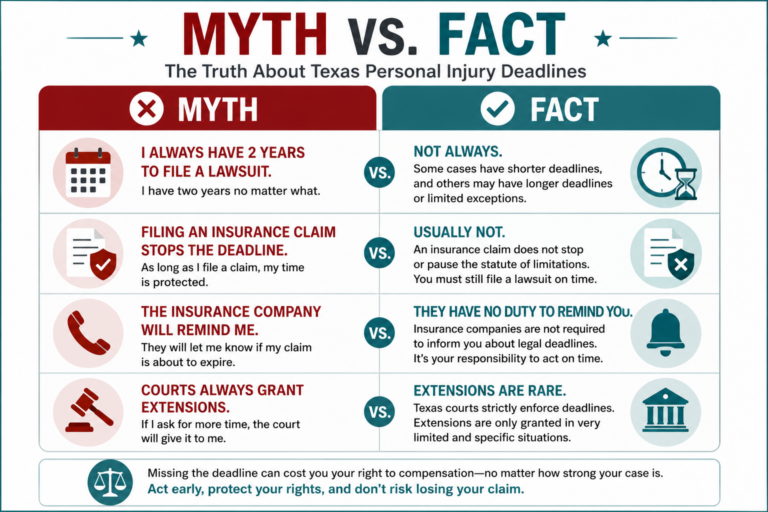
| I always have exactly two years to file a lawsuit. | Not always. Some claims have different deadlines or special notice requirements. |
| Filing an insurance claim protects my legal rights. | Usually not. Filing an insurance claim generally does not stop the statute of limitations.For additional consumer information about insurance claims, visit the Texas Department of Insurance. |
| The insurance company will remind me before the deadline expires. | Insurance companies generally have no duty to notify you that the filing deadline is approaching. |
| I can always ask the court for more time. | Extensions are limited and apply only in certain situations recognized by Texas law. |
| Waiting until the last week is okay if I file before the deadline. | Waiting can make it harder to preserve evidence, locate witnesses, and prepare your lawsuit before time runs out. |
Frequently Asked Deadline Scenarios
The Texas statute of limitations can feel simple at first. In many cases, the deadline is two years. However, real-life situations can make the deadline harder to understand.
Here are common scenarios that accident victims often ask about.
What if I am still receiving medical treatment?
You should not assume the deadline is paused just because you are still treating. In many cases, the statute of limitations continues to run while you receive medical care.
What if the insurance company is still negotiating?
Settlement talks usually do not stop the filing deadline. If the statute of limitations expires before a lawsuit is filed, the insurance company may have little reason to keep negotiating.
What if I was partially at fault?
Being partially at fault does not usually change the filing deadline. However, it may affect how much compensation you can recover under Texas comparative fault rules.
What if my child was injured?
Claims involving minors can involve special deadline rules. Parents may also have separate claims with their own deadlines, so it is important to get legal guidance early.
What if I did not know I was injured right away?
Some injuries become worse over time or are not diagnosed right away. In limited situations, Texas law may recognize a later start date. These exceptions are narrow and depend on the facts.
Key Takeaway
The safest approach is to treat the deadline seriously from the beginning. Even if an exception might apply, you should not rely on it without speaking to an attorney.
Understanding the Texas Statute of Limitations Can Protect Your Rights
The Texas statute of limitations is one of the most important laws affecting personal injury claims. While many cases follow the general two-year deadline, exceptions may apply depending on the facts of your case. Because Texas statutes and court decisions continue to shape how filing deadlines are applied, every case should be evaluated based on its unique facts and the applicable law.
Understanding your filing deadline is only one part of protecting your claim. Acting quickly can also help preserve evidence, identify witnesses, and give your attorney more time to build the strongest case possible.
If you have questions about how the Texas statute of limitations applies to your situation, it is often better to seek answers sooner rather than later. Waiting too long could affect both your evidence and your legal rights.
Key Takeaway
Most Texas personal injury lawsuits must be filed within two years, but every case is different. Knowing your deadline—and acting before it expires—can make a significant difference in protecting your right to pursue compensation.
Sources & References
This guide is based on Texas statutes, court decisions, government resources, and legal research available at the time of publication. It is intended for educational purposes and should not be considered legal advice. Because laws change, always consult the current law or speak with a qualified attorney about your specific situation.
Texas Statutes
- Texas Civil Practice & Remedies Code § 16.003 – Limitations Period for Personal Injury Claims
- Texas Civil Practice & Remedies Code § 16.001 – Legal Disability
- Texas Tort Claims Act (Chapter 101)
- Texas Wrongful Death Act (Chapter 71)
Texas Court Decisions
- Childs v. Haussecker, 974 S.W.2d 31 (Tex. 1998) – Leading Texas Supreme Court case discussing the Discovery Rule.
Government Resources
- Texas Department of Insurance
- Texas Judicial Branch
- National Highway Traffic Safety Administration (NHTSA)
- Federal Motor Carrier Safety Administration (FMCSA)
Legal Research
Explore More Texas Injury Law Guides
Understanding the statute of limitations is only one part of protecting your rights after an accident. Explore these additional guides to learn more about Texas personal injury law, insurance claims, settlements, and the legal process.
Texas Comparative Fault Guide
Learn how being partially at fault may affect your ability to recover compensation after an accident.
Texas Hospital Liens Guide
Understand how hospital liens work and how they may affect your personal injury settlement.
Texas Paid vs. Incurred Guide
Learn how Texas law treats medical expenses and why paid versus incurred matters in injury cases.
Texas Uninsured & Underinsured Motorist Guide
Discover how UM/UIM coverage may protect you when the at-fault driver has little or no insurance.
What to Do After a Car Accident in Texas
Follow the important steps that can help protect both your health and your personal injury claim after a crash.
How the Insurance Game Works After a Texas Accident
Learn how insurance companies investigate claims, evaluate injuries, and determine settlement offers after a Texas accident.