
Texas Comparative Fault Guide: Understanding the 51% Rule
Part of the Texas Injury Law Library
The Texas Injury Law Library is a collection of educational resources published by The Miller Law Firm, home of The Texas Bulldog. These guides explain important Texas personal injury laws, insurance rules, and legal concepts in plain English. This guide focuses on Texas comparative fault law, including the 51% rule. It also explains how fault percentages are assigned and how shared responsibility can affect an injury claim.
Last Updated: June 2026
Quick Answer
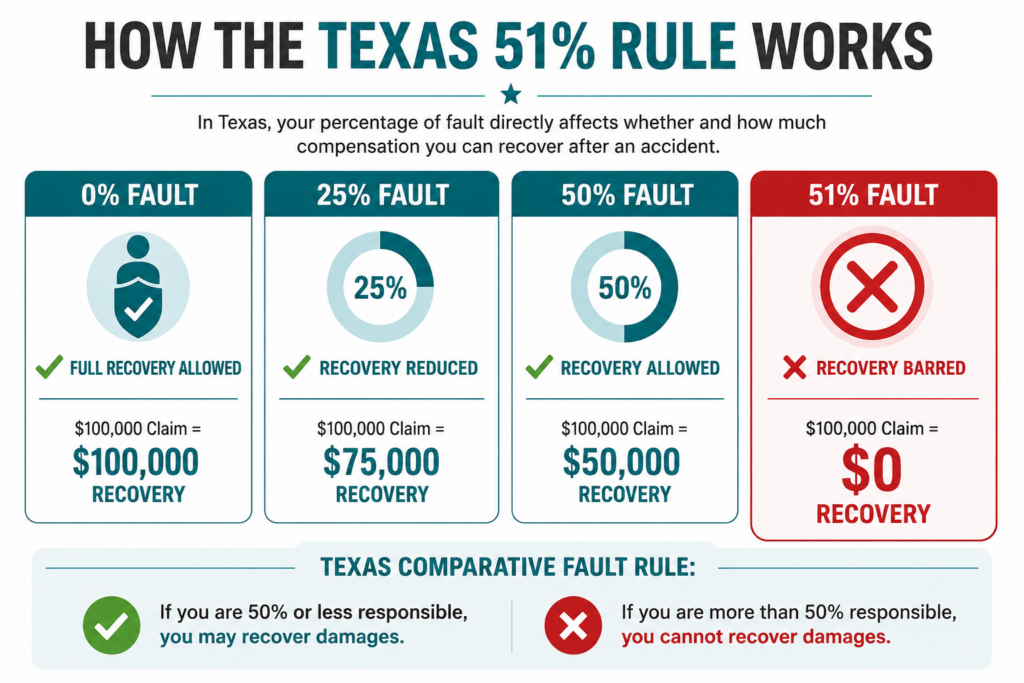
Texas follows a modified comparative fault system known as proportionate responsibility. Under Texas law, an injured person may recover compensation after an accident if they are 50% or less responsible for what happened. But if a person is found to be more than 50% at fault, they cannot recover damages from the other responsible parties.
When an injured person shares some responsibility for an accident, any compensation they receive is reduced by their percentage of fault. For example, suppose a person suffers $100,000 in damages but is found 20% responsible for the accident. Their recovery would then be reduced to $80,000.
Texas comparative fault laws can affect many types of personal injury cases, including:
- Car accidents
- Truck accidents
- Motorcycle crashes
- Pedestrian accidents
- Premises liability claims
Understanding how fault is determined can significantly affect the value of an injury claim. The same is true for understanding how responsibility is allocated.
Table of Contents
- What Is Comparative Fault?
- What Does Texas Law Call Comparative Fault?
- Understanding the Texas 51% Rule
- How Comparative Fault Affects Compensation
- Examples of Comparative Fault in Texas
- How Fault Is Determined After an Accident
- Evidence Used to Prove Fault
- How Insurance Companies Use Comparative Fault
- Responsible Third Parties Under Texas Law
- Comparative Fault vs. Contributory Negligence
- Common Myths About Texas Comparative Fault
- Frequently Asked Questions
- Sources and Legal Authorities
What Is Comparative Fault?
Comparative fault is a legal principle. It helps determine how responsibility should be divided when more than one person contributes to an accident or injury. Instead of assigning all blame to a single party, comparative fault allows responsibility to be shared among multiple people based on their actions.
In Texas, this concept is part of the state’s proportionate responsibility law. This law can affect several things. These include how fault is assigned, whether an injured person can recover damages, and how much compensation may be available after an accident.
In many personal injury cases, both sides may claim that the other party caused the accident. A driver may argue that another motorist was speeding, while the other driver claims someone failed to yield the right of way. Comparative fault laws help determine each person’s percentage of responsibility and how that responsibility affects the injury claim.
For example, if one driver was speeding while another driver failed to yield, a jury may determine that both drivers share responsibility for the collision and allocate fault accordingly.
Comparative fault can apply to many types of Texas injury claims, including:
- Car accidents
- Truck accidents
- Motorcycle accidents
- Pedestrian accidents
- Uber/Lyft Accidents
- Bicycle accidents
- Multi-Vehicle Accidents
- Dui/Dwi Accidents
The percentage of fault assigned to each party can significantly impact the amount of compensation available after an accident. As a result, determining fault is often one of the most important issues in a Texas personal injury case.
What Does Texas Law Call Comparative Fault?
Many people use the terms comparative fault and comparative negligence interchangeably. However, Texas law officially refers to this legal concept as proportionate responsibility. The rules governing proportionate responsibility are contained in Chapter 33 of the Texas Civil Practice and Remedies Code.
Under Texas proportionate responsibility law, fault may be assigned to multiple people or entities involved in an accident. The law does not place all blame on a single person. Instead, it allows responsibility to be divided among all parties whose actions contributed to the injury.
This system is used in many types of Texas personal injury claims, including car accidents, truck accidents, motorcycle accidents, and pedestrian accidents. The same principles may also apply in certain premises liability and workplace injury cases.
Texas follows a modified comparative fault system known as proportionate responsibility. Under Section 33.001 of the Texas Civil Practice and Remedies Code, an injured person may recover damages. This applies as long as their percentage of responsibility does not exceed 50%.
The concept of proportionate responsibility has been analyzed extensively by legal scholars. For example, the Texas Tech Law Review notes that Chapter 33 fundamentally changed how Texas courts allocate fault and damages in civil litigation. Under this law, juries must evaluate the conduct of multiple parties instead of focusing solely on a single defendant.
The amount of compensation an injured person can recover often depends on the percentage of fault assigned to each party. As a result, determining responsibility is often one of the most important issues in a Texas personal injury case.
One of the most significant parts of Texas proportionate responsibility law is the state’s 51% rule. This rule determines whether an injured person may recover compensation at all and can dramatically affect the outcome of an injury claim.
Understanding the Texas 51% Rule
| Fault Percentage | Can Recover Damages? | Recovery on a $100,000 Claim |
|---|---|---|
| 0% | Yes | $100,000 |
| 10% | Yes | $90,000 |
| 25% | Yes | $75,000 |
| 50% | Yes | $50,000 |
| 51% | No | $0 |
| 75% | No | $0 |
Related Guide
Understanding who was at fault is only part of protecting your legal rights after an accident. It is equally important to understand the Texas statute of limitations for personal injury claims. Missing the filing deadline could prevent you from recovering compensation—even if you are found 50% or less at fault under Texas law.
How Comparative Fault Affects Compensation
Texas comparative fault laws do more than determine whether an injured person can recover compensation. They also determine how much compensation may be available. Even when an injured person is eligible to recover damages, their compensation is reduced by their percentage of responsibility.
Under Section 33.013 of the Texas Civil Practice and Remedies Code, damages are allocated according to each party’s percentage of responsibility. As a result, even a relatively small finding of fault can significantly reduce the value of a claim.
Example 1: Driver Found 10% Responsible
Assume a jury determines that an injured driver suffered $100,000 in damages after a collision. If the driver is found 10% responsible for the accident, the recovery would be reduced by 10%.
- Total damages: $100,000
- Fault percentage: 10%
- Recovery: $90,000
Example 2: Driver Found 30% Responsible
In another case, an injured driver may have been speeding slightly at the time of the crash. If a jury determines the driver was 30% responsible, the compensation would be reduced accordingly.
- Total damages: $100,000
- Fault percentage: 30%
- Recovery: $70,000
Example 3: Driver Found 50% Responsible
A person who is exactly 50% responsible may still recover damages under Texas law.
- Total damages: $100,000
- Fault percentage: 50%
- Recovery: $50,000
Example 4: Driver Found 51% Responsible
If the injured person is found more than 50% responsible, recovery is generally barred.
- Total damages: $100,000
- Fault percentage: 51%
- Recovery: $0
Because fault percentages can dramatically affect compensation, insurance companies often attempt to shift blame to injured victims. Adjusters may argue that a driver was distracted, speeding, or failed to maintain a proper lookout. They may also claim the driver contributed to the collision in some other way. Understanding these tactics is important when dealing with an insurance claim. Learn more in our Insurance Game resource.
Fault allocation disputes are common in car accident cases, truck accident claims, motorcycle crashes, and pedestrian accidents. The evidence available after a crash often plays a major role. It helps determine how responsibility is assigned and how much compensation may ultimately be recovered.
Examples of Comparative Fault in Texas
Comparative fault issues arise in many different types of personal injury cases. While every accident is unique, the following examples illustrate how Texas proportionate responsibility laws may affect a claim.
Rear-End Collisions
Many people assume the driver who rear-ends another vehicle is automatically 100% responsible. While rear drivers are often at fault, that is not always the case. For example, the lead driver may suddenly reverse, have non-functioning brake lights, or create an unexpected hazard. In these cases, a portion of the responsibility may be assigned to that driver.
Comparative fault disputes often arise in car accident cases when both drivers present different versions of what occurred. Dashcam footage, witness statements, vehicle damage, and accident reconstruction evidence can help determine fault.
Left-Turn Accidents
Drivers making left turns generally have a duty to yield to oncoming traffic. However, fault is not always assigned entirely to the turning driver. If an approaching vehicle was speeding, ran a red light, or was driving recklessly, responsibility may be shared between multiple parties.
These cases often involve disputes about reaction times, visibility, traffic signals, and driver conduct right away before impact.
Truck Accidents
Comparative fault can become even more complex in truck accident cases. Multiple parties may be involved, including the truck driver, trucking company, maintenance provider, cargo loader, or another motorist.
According to legal analysis published by the Texas Tech Law Review, Chapter 33 allows fault to be allocated among multiple responsible parties. As a result, determining responsibility in a commercial vehicle collision often requires a detailed investigation.
Motorcycle Accidents
Motorcyclists are sometimes unfairly blamed for accidents because of stereotypes about speed or aggressive riding. Insurance companies may attempt to argue that a rider contributed to a collision even when another driver violated traffic laws.
Evidence such as witness testimony, crash scene photographs, surveillance footage, and vehicle data can be critical. This is especially true in motorcycle accident claims where fault is disputed.
Pedestrian Accidents
Fault disputes often arise in pedestrian accident cases. A driver may claim that a pedestrian crossed outside a designated crosswalk. The pedestrian, in turn, may argue that the driver was distracted, speeding, or failed to yield.
Texas comparative fault laws allow responsibility to be allocated based on the specific facts of the case. Depending on the circumstances, both parties may share some degree of fault.
Premises Liability Claims
Comparative fault principles are not limited to vehicle accidents. They can also apply to premises liability cases involving slip and falls, inadequate security, unsafe walkways, or dangerous property conditions.
Property owners may argue that an injured person failed to pay attention to an obvious hazard. The injured person, in turn, may contend that the dangerous condition should have been corrected or clearly marked with a warning. In these situations, a jury may assign percentages of responsibility to both parties.
These examples demonstrate why fault allocation is often one of the most heavily contested issues in personal injury litigation. Even a small change in fault percentage can significantly impact the amount of compensation available under Texas law.
How Fault Is Determined After an Accident
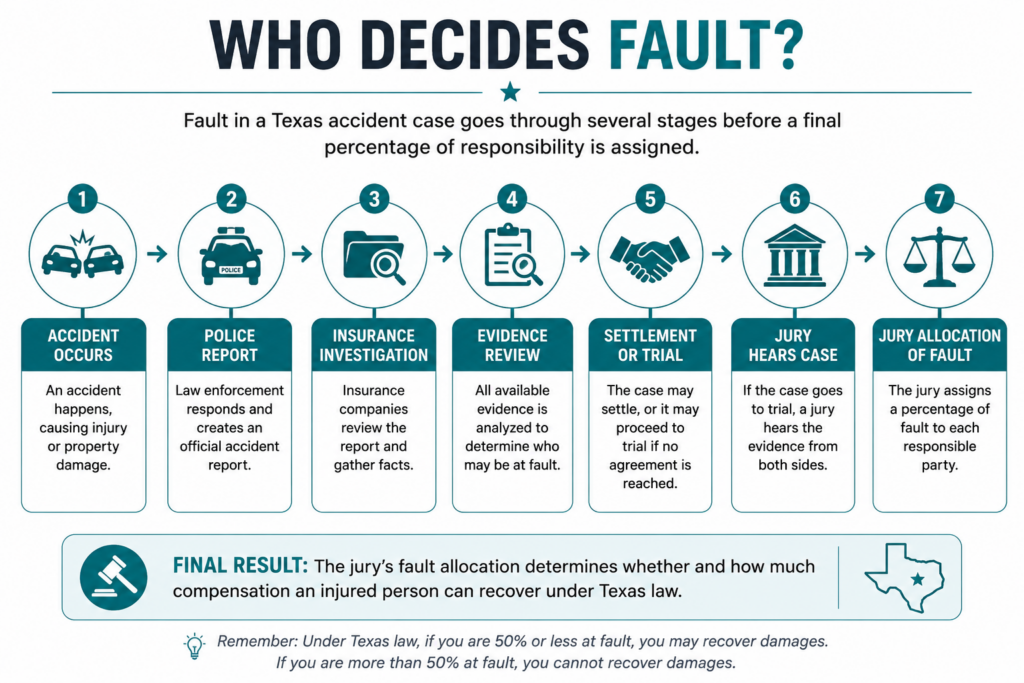
Many people assume that fault is determined solely by the police officer who responds to an accident. While a police report can be an important piece of evidence, it is only one factor considered when evaluating responsibility.
In Texas, insurance adjusters evaluate fault during the claims process. Attorneys representing the parties may also weigh in, and ultimately, a judge or jury decides if a lawsuit is filed. As additional evidence becomes available, fault determinations can change significantly over the life of a case.
Insurance Companies Often Make the First Fault Determination
After an accident, insurance companies typically conduct their own investigation. Adjusters review police reports, photographs, witness statements, vehicle damage, recorded statements, and other evidence to determine how they believe the accident occurred.
Compensation can be reduced based on comparative fault. Because of this, insurance companies often have a financial incentive to argue that an injured person shares responsibility for the accident. Understanding how evidence is collected and preserved after a crash can significantly affect fault determinations. Our What Should I Do After a Car Accident? guide explains important steps that may help protect evidence and strengthen a claim.
Police Reports Are Important but Not Final
Police officers often document important information at the scene, including witness statements, roadway conditions, diagrams, and any traffic citations that were issued. However, the officer’s opinion is not necessarily the final word on liability.
In some cases, evidence discovered later may contradict initial assumptions about how the accident occurred. Video footage, electronic vehicle data, expert analysis, and additional witness testimony may reveal facts that were not available at the scene.
Juries Ultimately Decide Fault in Many Lawsuits
If a personal injury case proceeds to trial, a jury may determine each party’s percentage of responsibility. Texas juries are often asked to allocate fault among multiple parties based on the evidence presented during the case.
Under Section 33.003 of the Texas Civil Practice and Remedies Code, juries may assign percentages of responsibility to several parties. These can include claimants, defendants, settling parties, and certain designated responsible third parties.
The Texas Tech Law Review notes that Texas juries are often required to evaluate the conduct of multiple people and entities. This applies when determining proportionate responsibility.
Fault Determinations Can Change Over Time
Initial fault determinations are not always accurate. As an investigation progresses, new evidence may become available that changes how responsibility is allocated.
For example, a driver initially blamed for causing a collision may later obtain surveillance footage showing another vehicle ran a red light. Likewise, vehicle data recorders, cell phone records, or accident reconstruction analysis may reveal information that was unavailable right away after the crash.
Because fault percentages directly affect compensation under Texas comparative fault laws, preserving evidence as early as possible can be critical. In many cases, the strength of the available evidence plays a major role in determining who is ultimately held responsible for an accident.
Evidence Used to Prove Fault
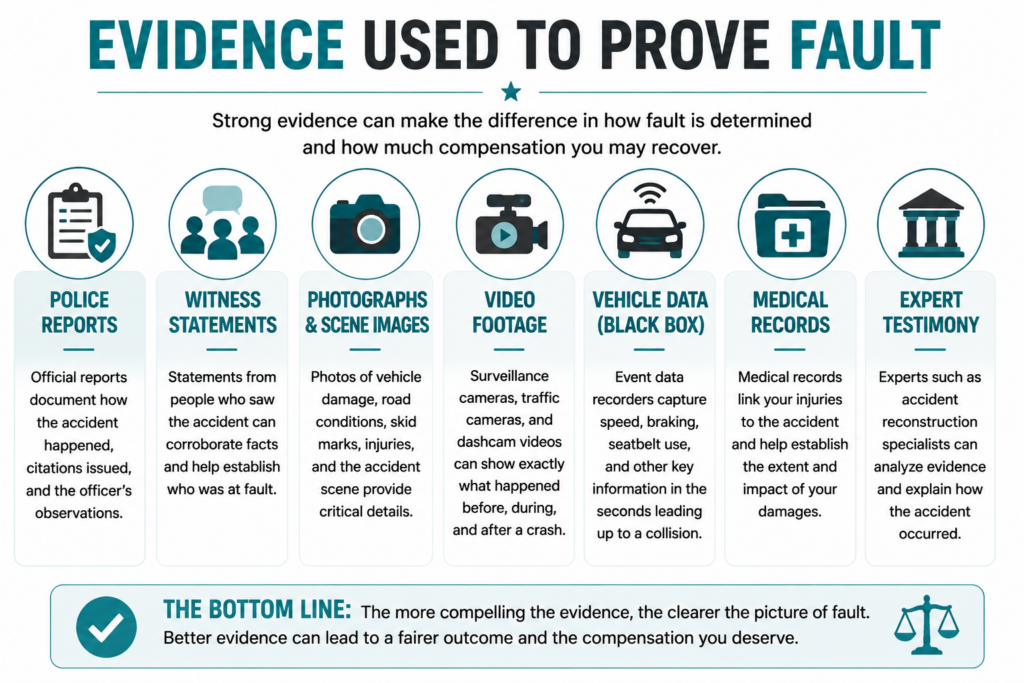
Texas follows a comparative fault system. Because of this, evidence often plays a critical role in determining who was responsible for an accident and whether an injured person can recover compensation. In many cases, the outcome of a claim depends on the quality and availability of the evidence collected after the incident.
Insurance companies, attorneys, accident reconstruction experts, and juries often rely on multiple forms of evidence when evaluating responsibility. Stronger evidence makes it harder for an opposing party to shift blame. It also makes it harder for them to unfairly increase an injured person’s percentage of fault.
Police Reports
A police report often serves as one of the first pieces of evidence reviewed after an accident. Officers may document roadway conditions, vehicle positions, witness statements, citations, and their observations from the scene. Although a police report does not automatically determine liability, it can provide valuable information during the investigation process.
Photographs and Video Evidence
Photos taken right away after an accident can help preserve important evidence before vehicles are moved or conditions change. Images of vehicle damage, skid marks, debris, traffic signals, weather conditions, and visible injuries may help establish how a collision occurred.
Video evidence is often even more persuasive. Dashcam recordings and surveillance footage from nearby businesses can provide an objective record of a crash. Traffic cameras and residential security cameras can offer this same kind of record.
Witness Statements
Independent witnesses can provide important information. This includes vehicle speeds, traffic signal changes, driver behavior, and other factors that may have contributed to an accident. Because witnesses generally have no financial interest in the outcome of a claim, their testimony is often given significant weight.
Electronic Vehicle Data
Many modern vehicles contain event data recorders, sometimes referred to as “black boxes.” These systems may record information such as vehicle speed, braking activity, throttle position, and steering inputs. They may also capture seatbelt usage in the moments before a collision.
Electronic data can be particularly important in serious truck accident cases. Commercial vehicles may contain additional onboard systems that track hours of service, vehicle location, speed, and driver activity.
Cell Phone Records
When distracted driving is suspected, cell phone records can help. They may establish whether a driver was texting, calling, using social media, or otherwise distracted at the time of an accident. This evidence can significantly affect fault determinations in certain cases.
Accident Reconstruction Experts
In complex cases involving disputed liability, accident reconstruction experts may analyze physical evidence, vehicle damage, roadway markings, electronic data, photographs, and witness testimony. Their goal is to determine how an accident occurred.
These experts often use scientific methods to evaluate speed, impact angles, reaction times, visibility conditions, and other factors that may influence fault allocation. Their findings can help insurance companies, attorneys, and juries understand how an accident happened and which parties may share responsibility.
Medical Records
Medical records may also affect fault disputes. Insurance companies sometimes argue that a delay in treatment means an injury was not serious. They may also claim it was caused by something other than the accident. Prompt medical evaluation can help document injuries and establish a connection between the accident and the damages being claimed.
Fault allocation can directly affect compensation under Texas law. Because of this, preserving evidence as quickly as possible is often one of the most important steps an injured person can take after an accident. Valuable evidence can disappear, be overwritten, or become unavailable if not secured promptly.
If you have been involved in a collision, our What Should I Do After a Car Accident? guide can help. It provides additional information about preserving evidence and protecting your rights after a crash.
How Insurance Companies Use Comparative Fault
Because Texas follows a comparative fault system, insurance companies often investigate whether an injured person contributed to an accident. If an insurer can successfully argue that a claimant shares responsibility, it may reduce the amount of compensation the company must pay.
In some cases, fault allocation is straightforward. In others, insurers may closely examine the actions of every party involved in an effort to increase the injured person’s percentage of responsibility. Even a relatively small increase in fault allocation can have a significant impact on the value of a claim.
For example, if an injured person suffers $100,000 in damages and is found 10% responsible, the recovery may be reduced to $90,000. If the fault allocation increases to 30%, the recovery may drop to $70,000. Because of this, disputes about fault often become one of the most contested aspects of a personal injury case.
Claiming the Injured Person Was Distracted
One common defense is to argue that the injured person was distracted before the accident occurred. Insurance companies may review cell phone records, social media activity, witness statements, and other evidence. Their goal is to show that the claimant failed to exercise reasonable care.
Alleging Speeding or Unsafe Driving
Insurance companies often argue that a driver was speeding, following too closely, changing lanes improperly, or otherwise operating a vehicle negligently. Even when another driver clearly caused a collision, insurers may attempt to assign a percentage of fault to the injured person.
Using Recorded Statements Against Claimants
Shortly after an accident, insurance adjusters may request a recorded statement. Many people believe they are simply providing information about the crash. However, statements made during these conversations can later be used to challenge liability or minimize damages.
For example, an innocent comment such as “I never saw the other vehicle” may be used against the claimant later. It could be characterized as an admission that the claimant was not paying attention.
Arguing That Injuries Were Not Caused by the Accident
In addition to disputing fault, insurers may argue that an injury was caused by a pre-existing condition rather than the accident itself. Medical records, treatment history, and expert opinions often play an important role in these disputes.
Attempting to Shift Blame to Other Parties
Texas law allows responsibility to be allocated among multiple parties. As a result, insurance companies may try to shift blame elsewhere. This could mean blaming another driver, a third party, a vehicle manufacturer, or even the injured person. According to Section 33.003 of the Texas Civil Practice and Remedies Code, fault may be apportioned among multiple responsible parties.
Understanding how these tactics work can help accident victims protect their rights and avoid common mistakes during the claims process. Our guide on How to Compare Texas Personal Injury Lawyers discusses important factors to consider when evaluating legal representation after a serious accident.
Fault allocation can directly affect compensation under Texas law. Because of this, preserving evidence, obtaining medical treatment, and understanding the claims process are often critical steps after an accident.
Responsible Third Parties Under Texas Law
One aspect of Texas comparative fault law often surprises accident victims. Responsibility may be assigned to people or entities who are not directly involved in the lawsuit. Texas refers to these people or entities as responsible third parties.
Under Section 33.004 of the Texas Civil Practice and Remedies Code, a defendant may ask the court to designate a responsible third party. This is someone whose conduct allegedly contributed to the claimant’s injuries.
The purpose of this law is to let juries evaluate the actions of everyone who may have contributed to an accident. This applies even if that person or entity is not a defendant in the case. This can have a significant impact on how fault is allocated and how damages are ultimately distributed.
Examples of Responsible Third Parties
Depending on the circumstances, a responsible third party may include:
- Another driver involved in a multi-vehicle collision
- An employer whose employee contributed to an accident
- A construction contractor responsible for creating a roadway hazard
- A maintenance company that failed to repair dangerous equipment
- A vehicle manufacturer whose defective product contributed to a crash
- A property owner whose negligence contributed to an injury
How Responsible Third Parties Affect Fault Allocation
When a responsible third party is designated, a jury may consider that person’s conduct when assigning percentages of responsibility. As a result, fault may be divided among multiple people or organizations rather than being assigned solely to the claimant and defendant.
For example, imagine a commercial truck collision involving a truck driver, a trucking company, and a third-party maintenance provider. Suppose evidence shows the maintenance company failed to properly service the truck’s braking system. A jury may then consider that conduct when determining responsibility for the accident.
In these situations, fault percentages may be allocated among several parties, with each party bearing responsibility for their share of the damages.
Why Responsible Third Parties Matter
Responsible third party designations often become a major issue in complex litigation because they can significantly affect fault allocation. Defendants often use these designations to argue that someone else shares responsibility for an accident.
Legal scholars have extensively analyzed Texas’s proportionate responsibility framework because of its unique approach to allocating fault among multiple parties. The Texas Tech Law Review notes that Chapter 33 requires courts and juries to evaluate the conduct of many people and entities. This applies when determining responsibility in many civil cases.
Understanding the role of responsible third parties is important because fault allocation does not always involve only the injured person and the defendant. In many cases, responsibility may be spread among several parties whose actions contributed to the event.
Comparative Fault vs. Contributory Negligence
Many people use the terms comparative fault, comparative negligence, and contributory negligence interchangeably. However, these legal concepts are not the same, and the differences can significantly affect an injured person’s ability to recover compensation.
Texas follows a modified comparative fault system known as proportionate responsibility. Under this system, an injured person may recover damages as long as their percentage of responsibility does not exceed 50%.
Contributory negligence is a much stricter rule. In states that follow contributory negligence, an injured person may be completely barred from recovering compensation if they contributed to the accident in any way. This is true even if their fault was minimal.
How Comparative Fault Works
Under Texas law, responsibility is divided among the parties based on their conduct. If an injured person is partially responsible for an accident, their compensation is reduced by their percentage of fault.
For example, a person who suffers $100,000 in damages but is found 20% responsible may still recover $80,000.
This approach attempts to allocate responsibility more fairly by holding each party accountable for their share of the fault.
How Contributory Negligence Works
Under a pure contributory negligence system, an injured person may recover nothing if they contributed to the accident at all. Even a finding of 1% fault could completely bar recovery.
Many courts and legal scholars viewed this outcome as overly harsh. Because of this, most states moved away from contributory negligence and adopted some form of comparative fault system.
Texas Is a Comparative Fault State
Texas does not follow contributory negligence. Instead, Texas applies the proportionate responsibility framework found in Chapter 33 of the Texas Civil Practice and Remedies Code.
As discussed in the SMU Law Review’s analysis of comparative negligence, comparative fault systems were developed to allocate damages according to each party’s responsibility. This approach avoids completely preventing recovery based on a minor mistake.
| Issue | Texas Comparative Fault | Contributory Negligence |
|---|---|---|
| Partial Fault Allowed? | Yes | No |
| Recovery Reduced by Fault? | Yes | No |
| Can 1% Fault Prevent Recovery? | No | Yes |
| Used in Texas? | Yes | No |
Understanding the distinction between comparative fault and contributory negligence is important because many online resources use the terms incorrectly. Texas accident victims are generally not prevented from recovering compensation simply because they share some responsibility for an accident. Instead, the amount they recover is typically adjusted according to their percentage of fault.
Common Misconceptions About Texas Comparative Fault
Texas comparative fault laws are often misunderstood. Many accident victims assume they cannot recover compensation if they made a mistake or believe that fault is determined right away after a crash. In reality, Texas law is often more nuanced than many people realize.
Can I Recover Compensation If I Was Partially at Fault?
Yes. Under Texas’s proportionate responsibility system, an injured person may still recover damages if their percentage of responsibility does not exceed 50%.
In many accidents, both parties share some degree of fault. The key question is not whether an injured person made a mistake. It is whether their percentage of responsibility exceeds the threshold established by Texas law.
Does the Police Report Determine Fault?
Police reports are important, but they do not automatically determine liability. Insurance companies, attorneys, judges, and juries may all consider additional evidence that was not available to the responding officer at the scene.
Witness testimony, surveillance footage, electronic vehicle data, expert analysis, and other evidence may affect how fault is ultimately allocated.
Does the Insurance Company Have the Final Say on Fault?
No. Insurance companies often make an initial determination about fault, but their decision is not legally binding.
Fault assessments may change as additional evidence becomes available. If a lawsuit is filed, a jury may ultimately determine each party’s percentage of responsibility based on the evidence presented during the case.
Are Rear-End Drivers Always Responsible?
Rear-end collisions often result in fault being assigned to the trailing driver. However, there are exceptions. Issues involving sudden reversals, defective brake lights, unexpected roadway hazards, and other unusual circumstances may affect fault allocation.
Every accident must be evaluated based on its specific facts and evidence.
Does Comparative Fault Only Apply to Car Accidents?
No. Comparative fault principles apply to many different types of personal injury cases.
The same rules may affect truck accidents, motorcycle crashes, pedestrian injuries, premises liability claims, workplace incidents involving third parties, and other negligence cases.
Can Fault Percentages Change During a Case?
Yes. Fault determinations often evolve as an investigation progresses. New witness statements, video footage, accident reconstruction analysis, electronic data, and expert testimony may significantly alter how responsibility is allocated.
It is not uncommon for an insurance company’s initial assessment of fault to change after additional evidence is discovered.
Does a Small Percentage of Fault Really Matter?
Absolutely. Even a relatively small percentage of fault can have a large impact on compensation.
A claimant who is assigned 20% responsibility for an accident may see their recovery reduced significantly. Depending on the value of the claim, this could mean thousands or even hundreds of thousands of dollars. For this reason, disputes about fault allocation are often among the most heavily contested issues in personal injury litigation.
Understanding how Texas comparative fault laws actually work can help accident victims make informed decisions. It can also help them avoid common misconceptions that may affect their claims.
Frequently Asked Questions About Texas Comparative Fault
Can I sue if I was partially at fault in Texas?
Yes. In Texas, you may still recover damages if your percentage of responsibility does not exceed 50%. However, your recovery may be reduced by your percentage of fault.
What happens if I am exactly 50% at fault?
If you are exactly 50% responsible, you may still recover compensation. Your damages would typically be reduced by 50%.
What happens if I am 51% at fault?
If you are found 51% or more responsible, Texas law generally bars you from recovering damages from the other responsible parties.
Does the police report decide who is at fault?
No. A police report can be important evidence, but it does not automatically decide fault. Insurance companies, attorneys, judges, and juries may consider additional evidence before responsibility is finally determined.
Can fault percentages change after an accident?
Yes. Fault percentages can change as new evidence becomes available. Video footage, witness statements, electronic vehicle data, expert analysis, and medical records may all affect how responsibility is assigned.
Can multiple people share fault for the same accident?
Yes. Texas law allows responsibility to be divided among multiple parties. This may include drivers, employers, property owners, manufacturers, contractors, or other responsible third parties.
Does comparative fault apply to truck accidents?
Yes. Comparative fault can apply to truck accident cases. These claims often involve multiple parties, including truck drivers, trucking companies, maintenance providers, cargo loaders, and other motorists.
Does comparative fault apply to motorcycle accidents?
Yes. Comparative fault can apply to motorcycle accident claims. Insurance companies may argue that a rider contributed to the crash, so evidence is especially important in disputed motorcycle cases.
Does comparative fault apply to pedestrian accidents?
Yes. Comparative fault may apply to pedestrian accident cases. A driver may claim that a pedestrian crossed outside a crosswalk. The pedestrian, in turn, may argue that the driver was speeding, distracted, or failed to yield.
What evidence helps prove fault?
Useful evidence may include:
- Police reports
- Photographs
- Dashcam footage
- Surveillance video
- Witness statements
- Vehicle data
- Cell phone records
- Medical records
- Accident reconstruction analysis
Can an insurance company blame me even if the other driver caused the crash?
Yes. Insurance companies may argue that an injured person shares some responsibility for an accident. This is one reason preserving evidence and avoiding careless recorded statements can be important.
What is a responsible third party?
A responsible third party is a person or entity that may have contributed to an accident. They are not necessarily a defendant in the lawsuit. Texas law allows fault to be allocated to certain responsible third parties in some cases.
Sources and Legal Authorities
This guide is intended to provide a plain-English explanation of Texas comparative fault law. The following legal authorities and reference materials may be helpful for readers. They offer additional information about proportionate responsibility, fault allocation, and personal injury claims in Texas.
Texas Statutes
- Texas Civil Practice and Remedies Code Chapter 33
- Texas Civil Practice and Remedies Code §33.001
- Texas Civil Practice and Remedies Code §33.003
- Texas Civil Practice and Remedies Code §33.004
- Texas Civil Practice and Remedies Code §33.013
Legal Research and Academic Resources
- Texas Tech Law Review – Chapter 33 and Proportionate Responsibility
- SMU Law Review – Comparative Negligence Research
- Texas State Law Library
Texas Courts and Jury Resources
Laws may change, and every case presents unique facts. For this reason, readers should consult the current version of the statutes and applicable legal authorities when researching a specific legal issue.
Attorney Insight
One of the biggest mistakes injured people make is assuming fault has already been decided. An insurance company’s first opinion about responsibility is not the final answer. Police reports, photographs, witness statements, vehicle data, medical records, and expert analysis may all change how fault is ultimately assigned.
At The Miller Law Firm, home of The Texas Bulldog, we often see insurance companies try to increase an injured person’s percentage of fault. Their goal is to reduce the value of a claim. Many injured people also feel pressured to accept a quick settlement before fault disputes are fully investigated. Understanding the difference between trial-ready law firms and settlement mills can be important when evaluating legal representation. Learn more in our guide: Trial-Ready vs. Settlement Mill Law Firms in Texas.
For that reason, a thorough investigation is important. The stronger the evidence, the harder it becomes for an insurance company or opposing party to unfairly shift blame.
Questions About Comparative Fault?
Understanding Texas comparative fault law can be challenging, especially when insurance companies argue that an injured person shares responsibility for an accident. Because fault allocation can directly affect compensation, it is important to understand your rights and the evidence that may impact a claim.
Do you have questions about comparative fault, the Texas 51% rule, or how fault may affect a Texas personal injury case? Contact The Miller Law Firm, home of The Texas Bulldog.
Call 713-572-3333 for a free consultation.
Our office is located at 4900 Woodway Drive, Suite 900, Houston, Texas 77056. We proudly serve injury victims throughout Houston and across Texas.
