Last Updated: July 14, 2026
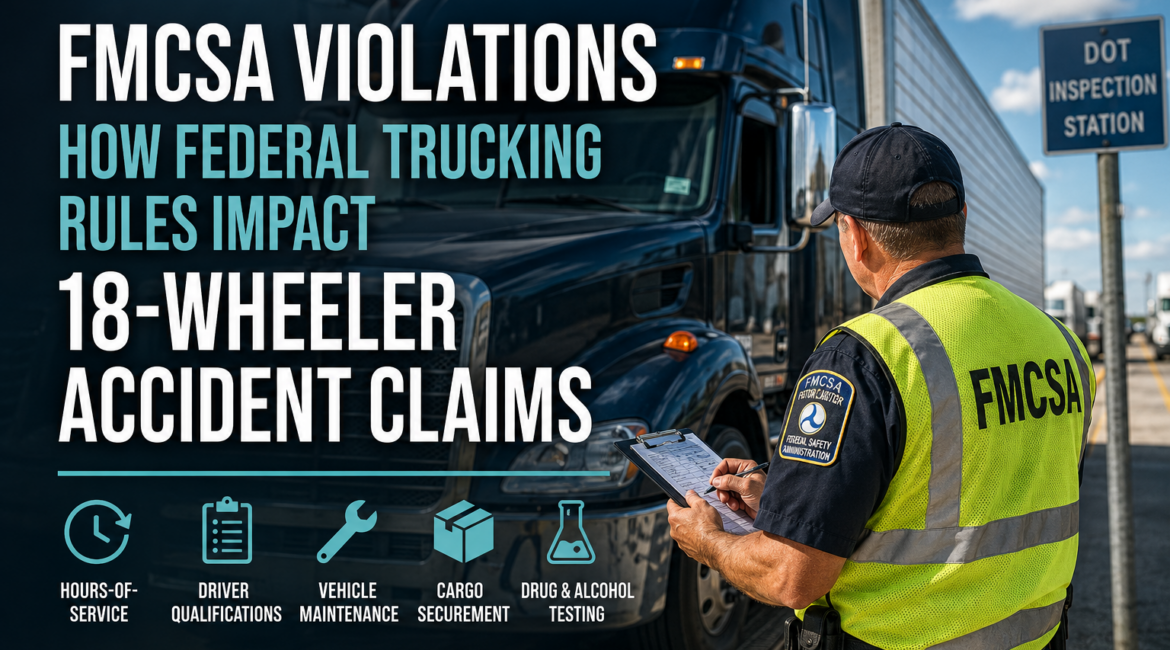
Commercial truck drivers and trucking companies must follow federal safety rules. These rules exist to prevent crashes. When a company breaks these rules, it can help explain why an 18-wheeler accident happened. An FMCSA violation can also show whether the driver, the motor carrier, or another company should be held responsible.
These cases are rarely simple. It is not just about which driver got a ticket. A serious truck crash often calls for a close look at company records — electronic driving logs, inspection reports, driver files, maintenance files, dispatch messages, and cargo documents. The trucking company usually controls this evidence.
Knowing the federal trucking rules helps injured people understand why these claims need a different kind of investigation than an ordinary car crash. Our Houston truck accident lawyers investigate whether FMCSA violations, unsafe company practices, or other failures contributed to the crash.
Quick Answer: How Can an FMCSA Violation Affect a Truck Accident Claim?
An FMCSA violation can show that a truck driver or motor carrier broke a federal safety rule. Records of excessive driving hours, falsified logs, poor maintenance, an unqualified driver, or unsecured cargo can help show how the crash happened and who may be responsible.
A violation does not automatically guarantee compensation. The evidence must still be connected to the collision, the injuries, and the losses being claimed.
Table of Contents
- What Is the FMCSA?
- Why FMCSA Regulations Matter After a Truck Accident
- Who Must Follow FMCSA Regulations?
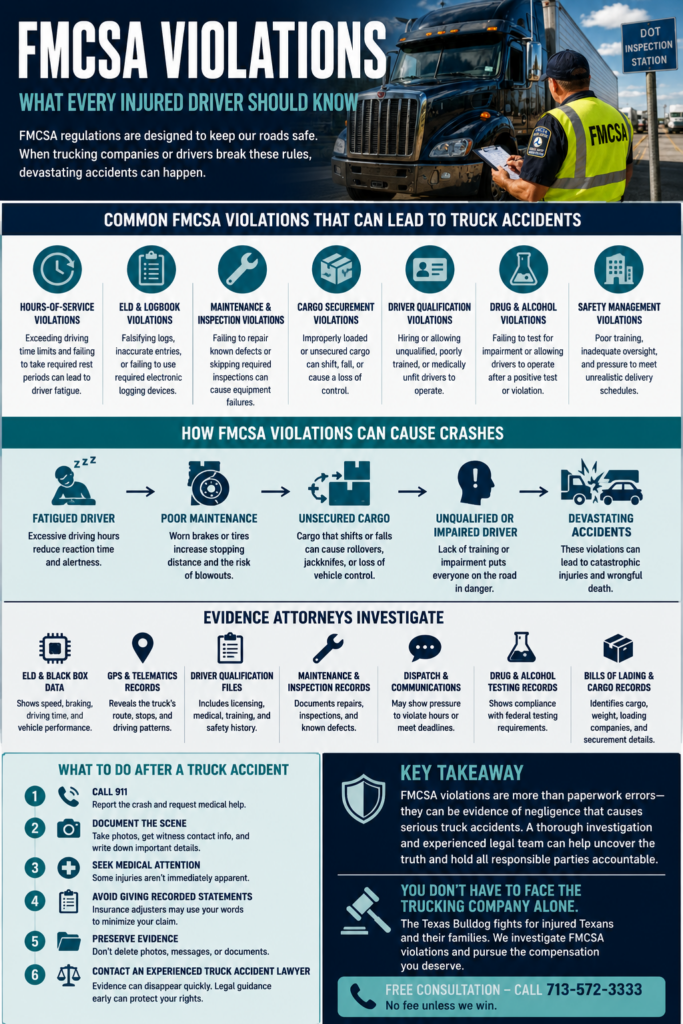
- Common FMCSA Violations That Can Cause Truck Accidents
- Hours-of-Service Violations
- Electronic Logging Device Violations
- Inspection, Repair, and Maintenance Violations
- Cargo Loading and Securement Violations
- Driver Qualification and Training Violations
- Drug and Alcohol Testing Violations
- How FMCSA Violations Can Cause Truck Accidents
- How Attorneys Investigate FMCSA Violations
- Does an FMCSA Violation Prove Negligence?
- Who May Be Liable for an FMCSA Violation?
- What to Do After a Commercial Truck Accident
- Frequently Asked Questions About FMCSA Violations
What Is the FMCSA?
The Federal Motor Carrier Safety Administration, commonly called the FMCSA, is an agency within the United States Department of Transportation. It regulates and oversees many aspects of commercial motor vehicle safety.
The agency establishes and enforces rules addressing subjects such as:
- Commercial driver hours and required rest periods
- Electronic logging devices and driving records
- Commercial driver licensing and medical qualifications
- Vehicle inspection, repair, and maintenance
- Drug and alcohol testing programs
- Cargo loading and securement
- Motor carrier safety practices and recordkeeping
These rules exist to reduce the risks created by large trucks, tight delivery schedules, long driving shifts, mechanical failures, and unsafe company practices.
FMCSA rules are mainly found in Title 49 of the Code of Federal Regulations. Which rules apply depends on the vehicle, cargo, route, driver, and type of operation.
Why FMCSA Regulations Matter After a Truck Accident
FMCSA rules can matter a great deal after a crash. They set safety duties that go beyond the rules for ordinary drivers.
For example, a regular driver does not have to keep an electronic record of every hour spent driving. A commercial driver often must log driving and on-duty time with an Electronic Logging Device, or ELD.
A trucking company has duties too. It may need to keep driver qualification files, run inspections, document repairs, enforce drug and alcohol testing, and track whether drivers follow federal hour limits.
If a serious truck crash occurs, these records may help answer questions such as:
- Was the driver too fatigued to operate safely?
- Did the driver exceed federal hours-of-service limits?
- Were electronic driving logs missing, inaccurate, or altered?
- Did the carrier hire a driver who was unqualified or medically unfit?
- Did the trucking company know that the truck had unsafe brakes or tires?
- Was cargo overloaded, improperly balanced, or inadequately secured?
- Did the company pressure the driver to violate safety rules to meet a deadline?
A thorough investigation looks past the driver’s version of events. It examines the whole trucking operation and the decisions made before the truck ever hit the road.
Key Insight
An FMCSA violation is most meaningful when the evidence connects the violation to the collision. An unrelated paperwork error may matter less than driving-hour records. Records showing a fatigued driver stayed behind the wheel past federal limits right before the crash can matter a great deal.
Who Must Follow FMCSA Regulations?
FMCSA rules apply broadly to motor carriers, commercial drivers, and commercial vehicles that cross state lines. The exact rules that apply depend on the vehicle’s weight, passenger capacity, cargo, route, and other factors.
Regulated vehicles may include:
- 18-wheelers and tractor-trailers
- Semi-trucks and freight trucks
- Tanker trucks
- Flatbed trucks
- Commercial delivery vehicles
- Some buses and passenger-carrying vehicles
- Vehicles transporting hazardous materials
Some Texas trucking operations must also follow state rules. Figuring out which rules apply means looking at where the carrier operates, the type of vehicle, what it was hauling, and the nature of the trip.
This is one reason trucking claims need a more specialized investigation than most car accident cases. Learn more about the evidence, companies, and insurance issues on our Houston truck accident attorney page.
Common FMCSA Violations That Can Cause Truck Accidents
Not every trucking violation causes a crash. But certain safety violations get close attention because they raise the risk of driver fatigue, mechanical failure, loss of control, and other hazards.
Common violations investigated after commercial truck accidents include:
- Exceeding hours-of-service limits
- Failing to take required driving breaks
- Using incomplete, inaccurate, or falsified electronic logs
- Operating a truck with unsafe brakes or tires
- Failing to complete required inspections
- Hiring or retaining an unqualified driver
- Failing to conduct required drug and alcohol testing
- Allowing an impaired driver to operate a commercial vehicle
- Improperly loading or securing cargo
- Operating an overloaded or unbalanced trailer
- Failing to repair a known mechanical defect
- Pressuring a driver to violate safety rules or delivery-hour limits
The records needed to identify these violations are often controlled by the trucking company or another commercial entity. They may not be included in the standard police crash report.
Hours-of-Service Violations
Driver fatigue is a serious concern in the trucking industry. Federal hours-of-service rules limit how long many commercial drivers may drive and remain on duty before resting.
According to the FMCSA’s official summary of hours-of-service regulations, property-carrying drivers are generally subject to several important limits:
- 11-hour driving limit: A driver may generally drive for a maximum of 11 hours after 10 consecutive hours off duty.
- 14-hour driving window: A driver generally may not drive beyond the 14th consecutive hour after coming on duty following 10 consecutive hours off duty.
- 30-minute break requirement: A qualifying driver must generally take a 30-minute interruption after eight cumulative hours of driving without a sufficient break.
- 60/70-hour limit: A driver generally may not drive after reaching 60 hours on duty in seven consecutive days or 70 hours in eight consecutive days, depending on the carrier’s operating schedule.
Exceptions can apply, so records must be reviewed carefully. Still, a pattern of long driving hours can suggest the driver was fatigued, or that the company put deadlines ahead of safety.
Evidence of an hours-of-service violation may include:
- ELD records
- Paper logs
- Fuel receipts
- Toll records
- GPS and telematics data
- Dispatch communications
- Bills of lading
- Pickup and delivery timestamps
- Cell phone records
Comparing records can show whether the driver’s official log matches the real trip. For example, a fuel receipt or toll record may show the truck was moving when the log says it was stopped.
Electronic Logging Device Violations
Electronic Logging Devices automatically record a driver’s activity and the truck’s movement. They are used to track driving time and enforce hours-of-service rules.
The FMCSA provides an official overview of Electronic Logging Device requirements and resources.
Potential ELD-related violations may involve:
- Failing to use a required ELD
- Using an unregistered or noncompliant device
- Failing to maintain required supporting documents
- Entering inaccurate duty-status information
- Improperly editing driving records
- Using another person’s account or driver identification
- Failing to report or correct device malfunctions
- Pressuring a driver to falsify or manipulate logs
An ELD alone does not always tell the full story. Attorneys often compare ELD data with GPS records, dispatch messages, fuel purchases, toll data, and delivery records to spot inconsistencies.
This evidence can be especially important when a driver claims to have been adequately rested but the commercial records suggest otherwise.
Injured in a Commercial Truck Accident?
Trucking companies may begin investigating a serious collision immediately. The Miller Law Firm – home of The Texas Bulldog — can investigate whether federal safety violations, driver fatigue, faulty equipment, or unsafe carrier practices contributed to the crash.
No fee unless we win. Free consultation.
Inspection, Repair, and Maintenance Violations
Commercial trucks travel long distances and carry heavy loads. This puts real stress on tires, brakes, steering, and coupling equipment. Federal rules require motor carriers to regularly inspect, repair, and maintain their trucks.
Maintenance-related violations may include:
- Operating with worn or improperly adjusted brakes
- Using damaged, underinflated, or excessively worn tires
- Ignoring steering or suspension defects
- Failing to repair defective lights or reflective equipment
- Operating with damaged coupling devices
- Failing to conduct required inspections
- Failing to document repairs
- Returning an unsafe truck to service
Maintenance records can show whether a problem appeared suddenly or was reported again and again without a fix. Inspection reports, repair invoices, work orders, and internal messages can all become important evidence.
Responsibility may extend beyond the driver. Depending on the facts, the motor carrier, truck owner, leasing company, repair shop, maintenance contractor, or parts manufacturer could be involved.
Cargo Loading and Securement Violations
Cargo must be loaded and secured so it cannot shift, roll, leak, or fall during transport. Improperly loaded cargo can change a trailer’s center of gravity, increase stopping distance, and cause a rollover or loss of control.
The FMCSA’s official cargo securement rules explain requirements intended to prevent cargo from shifting within or falling from commercial motor vehicles.
Potential cargo-related violations may include:
- Using too few tiedowns
- Using damaged or inadequate securement devices
- Failing to block or brace cargo properly
- Failing to restrain items that may roll
- Exceeding weight limits
- Improperly distributing cargo weight
- Failing to inspect the load during transport
- Using defective trailer doors, locks, or containment systems
These cases may involve the motor carrier, truck driver, shipper, warehouse, freight company, cargo-loading contractor, or another party responsible for preparing the load.
If cargo falls from a truck or causes a multi-vehicle crash, it matters a great deal who loaded, inspected, and controlled the shipment. Anyone involved should preserve photos, witness information, and other evidence. Our guide on what to do after a Texas accident explains steps that can help protect a claim.
Driver Qualification and Training Violations
Motor carriers must check that their drivers are properly licensed, medically qualified, and able to safely operate their assigned trucks. Hiring a driver takes more than just confirming a commercial license.
Depending on the operation, a trucking company may be required to investigate and maintain records concerning the driver’s:
- Commercial driver’s license and required endorsements
- Employment application and prior driving experience
- Driving record and history of traffic violations
- Prior commercial driving employers
- Medical certification and physical qualifications
- Road test or equivalent certification
- Annual review of driving performance
- Drug and alcohol testing history
Potential driver qualification violations may arise when a motor carrier:
- Allows someone to drive without the proper commercial license or endorsement
- Fails to investigate the driver’s safety history before hiring
- Ignores prior crashes, disqualifying offenses, or serious traffic violations
- Permits a medically unqualified driver to operate a commercial vehicle
- Fails to provide appropriate training for the truck, trailer, route, or cargo involved
- Continues employing a driver after learning that the driver presents a safety risk
- Fails to properly supervise or monitor the driver’s performance
A driver qualification file can show that the trucking company knew — or should have known — that a driver was not ready to drive safely. This evidence can support claims for negligent hiring, training, supervision, or retention.
The investigation may also look at whether the driver had enough experience with that specific type of vehicle. Driving a tanker, hauling hazardous materials, pulling multiple trailers, or moving an oversized load can require special training or endorsements.
Practice Tip
The police report usually does not contain the trucking company’s complete hiring, training, and supervision history. Driver qualification files and corporate records may reveal safety concerns that were not visible at the accident scene.
Drug and Alcohol Testing Violations
Commercial drivers must follow strict federal drug and alcohol rules. Motor carriers must run testing programs and keep a driver off the road when federal rules require it.
Testing may be required in circumstances involving:
- Pre-employment screening
- Random testing
- Certain commercial vehicle accidents
- Reasonable suspicion of drug or alcohol use
- Return-to-duty requirements
- Follow-up testing after a violation
Potential violations may include:
- Allowing a driver to operate after a positive drug or alcohol test
- Failing to perform a required pre-employment inquiry
- Failing to conduct required random testing
- Failing to perform post-accident testing when required
- Allowing a driver to return to work before completing required procedures
- Ignoring signs of impairment or substance misuse
- Failing to maintain accurate testing records
- Using an unqualified testing provider or improper testing procedure
FMCSA’s Drug and Alcohol Clearinghouse is a federal database of certain driver drug and alcohol violations. An investigation may check whether the carrier ran the required checks, and whether the driver was legally allowed to drive at the time of the crash.
Evidence of impairment may also come from police observations, toxicology results, witness statements, dash camera footage, receipts, cell phone records, or communications with the trucking company.
How FMCSA Violations Can Cause Truck Accidents
Federal trucking regulations address different safety risks, but violations often overlap. A single collision may result from several failures involving both the driver and the trucking company.
Examples include:
- A fatigued driver exceeds federal driving limits, fails to react to stopped traffic, and causes a rear-end collision.
- A carrier ignores repeated brake problems, and the truck cannot stop safely when traffic slows.
- An inexperienced driver receives inadequate training and loses control while navigating a curve or steep grade.
- Improperly secured cargo shifts inside the trailer, causing the truck to jackknife or roll over.
- An overloaded trailer increases stopping distance and places excessive strain on tires and braking components.
- A driver falsifies electronic logs to conceal excessive driving time and fatigue.
- A trucking company overlooks a disqualifying safety history and allows a dangerous driver to remain on the road.
- A maintenance provider fails to properly repair the truck, resulting in a tire, steering, or mechanical failure.
Investigating the violation is only part of the process. The evidence must also show how the unsafe conduct contributed to the collision and the resulting injuries.
Truck crashes often cause traumatic brain injuries, spinal cord damage, amputations, internal injuries, severe fractures, and other life-changing harm. Learn more in our overview of Texas catastrophic injury claims.
How Attorneys Investigate FMCSA Violations
Figuring out whether federal violations caused a crash usually takes more than the standard accident report. The trucking company and its insurers often hold the most important records.
A truck accident investigation may include obtaining and reviewing:
- Electronic Logging Device records documenting driving and on-duty time
- Engine Control Module or black box data showing speed, braking, throttle position, and other vehicle activity
- Driver qualification files containing licensing, medical, employment, and safety-history information
- Maintenance and inspection records showing reported defects, repairs, and service history
- Dispatch messages and delivery instructions revealing schedules or pressure placed on the driver
- GPS and telematics data documenting the truck’s route, movement, and location
- Dash camera footage capturing events inside or outside the truck
- Drug and alcohol testing records showing compliance with federal testing requirements
- Cargo records and bills of lading identifying the shipment, weight, loader, and responsible companies
- Roadside inspection and safety records documenting previous violations or out-of-service conditions
- Cell phone records that may reveal distraction or communications before the crash
- Police reports, photographs, video, and witness statements documenting the collision itself
These records should be compared, not reviewed alone. A driver’s electronic log may look compliant until it is checked against toll records, fuel receipts, GPS data, or delivery timestamps that show the truck moving during a claimed rest period.
Why Evidence Preservation Matters
Some electronic and company records get overwritten, deleted, or discarded during routine business. That is why attorneys often send an evidence preservation letter — sometimes called a spoliation letter — soon after a serious crash.
The letter may demand preservation of evidence such as:
- ELD and black box data
- Dash camera and surveillance footage
- Driver logs and qualification records
- Dispatch and internal communications
- Maintenance and inspection documents
- Drug and alcohol testing records
- GPS and telematics information
- The truck, trailer, tires, and damaged components
Prompt action can be especially important when the trucking company’s investigators and insurance representatives begin working immediately after the collision.
Does an FMCSA Violation Prove Negligence?
An FMCSA violation can be important evidence. But it does not automatically prove liability or guarantee compensation. Its legal weight depends on the rule involved, the facts of the crash, who broke the rule, and whether it contributed to the injuries.
A successful injury claim generally requires evidence showing:
- A legal duty existed. The driver, motor carrier, or another party had a duty to act with reasonable care or comply with an applicable safety requirement.
- The duty was breached. The party violated a regulation or otherwise failed to act reasonably.
- The breach caused or contributed to the crash. The unsafe conduct must be connected to the collision rather than merely being an unrelated paperwork violation.
- The victim suffered damages. The crash caused injuries, medical expenses, lost income, pain, impairment, or other legally recoverable losses.
For example, a carrier’s failure to update a form may have little to do with a rear-end collision. But ELD records showing a driver exceeded federal driving limits before falling asleep can go straight to the cause of the crash.
The trucking company may also argue that the injured person shares some fault. Texas uses a modified comparative responsibility system, which can reduce or block recovery depending on the percentage of fault assigned. Our Texas comparative fault guide explains how shared responsibility can affect a claim.
Who May Be Liable for an FMCSA Violation?
The truck driver is not automatically the only responsible party. A trucking operation often involves several businesses, each performing a different function or controlling a different part of the shipment.
Depending on the evidence, potentially responsible parties may include:
The Commercial Truck Driver
A driver may be responsible for speeding, distracted driving, fatigue, impairment, unsafe lane changes, falsified logs, inspection failures, or other negligent conduct.
The Motor Carrier or Trucking Company
A motor carrier can be responsible for its own negligence in hiring, training, supervision, maintenance, scheduling, or pressuring drivers to meet unsafe deadlines.
The Truck or Trailer Owner
A separate company may own or lease the tractor, trailer, or other equipment. Its maintenance responsibilities and knowledge of defects may become relevant.
The Cargo Loader or Shipper
A warehouse, shipper, loading contractor, or another company may be responsible when improperly loaded, overloaded, or unsecured cargo contributes to the crash.
A Maintenance or Repair Company
An outside service provider may share responsibility if negligent inspection or repair work allowed unsafe brakes, tires, steering components, or other equipment to remain in service.
A Freight Broker or Other Commercial Entity
A freight broker or another company that arranged the transportation may also face claims, depending on the facts and the law. These claims are highly fact-specific and can involve complex federal issues.
A Vehicle or Parts Manufacturer
A manufacturer may be involved if a defective tire, braking system, steering component, coupling device, trailer component, or other product contributed to the collision.
Identifying every responsible party matters because each one may hold different evidence, insurance coverage, and legal duties. Our Houston truck accident attorneys investigate the whole trucking operation instead of assuming the crash was only the driver’s mistake.
What to Do After a Commercial Truck Accident
The moments after a serious truck crash can be overwhelming. Your immediate priority should be obtaining medical care and protecting yourself from further harm.
When possible, the following steps may help protect your health and potential claim:
- Call 911 and report the collision. Request emergency medical assistance when anyone may be injured.
- Seek prompt medical treatment. Some serious injuries may not be immediately obvious because of shock or adrenaline.
- Photograph the scene. Capture the vehicles, truck and trailer numbers, company markings, cargo, roadway conditions, skid marks, debris, and visible injuries.
- Collect witness information. Independent witnesses may leave before the investigation is complete.
- Identify the commercial parties. Record the driver’s information, motor carrier name, USDOT number, license plate, trailer number, and insurance details when available.
- Avoid admitting fault. Provide accurate information without speculating about what caused the crash.
- Preserve documents and damaged property. Keep medical records, receipts, photographs, clothing, and other relevant evidence.
- Be cautious with insurance adjusters. A trucking insurer may request a recorded statement before you understand the extent of your injuries or your legal rights.
- Consider obtaining legal guidance promptly. Important trucking records and electronic data may not be preserved indefinitely.
Before providing a recorded statement to an insurance company, review our Texas recorded statement guide to understand how your answers may affect an injury claim.
Let The Texas Bulldog Investigate the Trucking Company
Evidence of driver fatigue, falsified logs, unsafe equipment, improper cargo loading, or negligent hiring may be hidden in records controlled by the trucking company. The Miller Law Firm can work to preserve that evidence and identify every party that may be responsible.
Free consultation. No fee unless we win.
Frequently Asked Questions About FMCSA Violations
What does FMCSA stand for?
FMCSA stands for the Federal Motor Carrier Safety Administration. It is the federal agency responsible for regulating and overseeing many aspects of commercial motor vehicle safety.
What are the most common FMCSA violations after a truck accident?
Common violations involve hours-of-service limits, electronic logging devices, vehicle maintenance, driver qualifications, drug and alcohol testing, cargo securement, inspections, and recordkeeping. The relevant violation depends on how the crash occurred.
Can I look up a trucking company’s FMCSA violations?
Some carrier registration, inspection, crash, and safety information is publicly available through federal databases. But public records rarely include everything needed to investigate a specific crash. Driver files, electronic data, maintenance records, and internal company communications usually require formal preservation and discovery.
Does an FMCSA violation automatically make the trucking company liable?
No. A violation may provide evidence of negligence, but it must generally be connected to the cause of the collision and the resulting injuries. An unrelated administrative violation may not establish liability by itself.
Can a trucking company be responsible for a driver’s violation?
Potentially, yes. A carrier can be responsible for its own conduct in hiring, training, supervision, maintenance, scheduling, or compliance. It may also share responsibility based on its relationship with the driver, depending on the facts and the law.
What is an hours-of-service violation?
An hours-of-service violation happens when a commercial driver breaks federal limits on driving time, on-duty time, rest periods, or recordkeeping. These violations matter most when fatigue played a role in the crash.
What is an ELD violation?
An ELD violation can involve skipping a required device, entering false information, improperly editing records, ignoring a malfunction, or hiding excessive driving time.
How long does a trucking company keep electronic evidence?
Retention periods vary by record type and regulation. Some vehicle systems overwrite data much sooner than a company discards its formal records. That is why prompt evidence preservation matters so much after a serious crash.
What if the truck driver was an independent contractor?
Calling a driver an independent contractor does not automatically settle liability. An investigation may look at the motor carrier’s operating authority, its control over the driver, ownership or leasing arrangements, dispatch practices, insurance coverage, and other companies’ roles.
What damages may be available after an FMCSA-related truck accident?
Depending on the circumstances, recoverable damages may include medical expenses, future medical care, lost wages, reduced earning capacity, physical pain, mental anguish, impairment, disfigurement, property damage, and other losses recognized under Texas law.
How long do I have to file a Texas truck accident claim?
Texas personal injury lawsuits generally have a two-year statute of limitations, though exceptions and shorter notice deadlines can apply. Waiting also makes evidence harder to preserve, so don’t treat the filing deadline as a reason to delay your investigation.
Should I speak with the trucking company’s insurance adjuster?
Use caution. The adjuster works for the insurance carrier and may look for information that limits the company’s payout. Get legal guidance before giving a recorded statement, signing a release, or accepting a settlement.
Talk to a Houston Truck Accident Lawyer About Possible FMCSA Violations
A commercial truck crash often involves more than one driver’s mistake. Excessive driving hours, inaccurate logs, poor maintenance, negligent hiring, unsafe cargo practices, and other company failures can all contribute to a serious crash.
At The Miller Law Firm — home of The Texas Bulldog — our Houston truck accident lawyers dig into the federal safety rules, company records, electronic data, and corporate decisions behind the crash. We build serious truck accident claims with a trial-ready approach and fight for the compensation injured Texans deserve.
Call 713-572-3333 or request a free consultation online. You pay no attorney’s fee unless we recover compensation for you.