
Losing a loved one because of someone else’s negligence is devastating. The grief is heavy and the questions pile up fast—What happened? Who is responsible? How do we pay the bills? In Texas, a wrongful death claim can hold careless individuals and corporations accountable while providing financial recovery for your family’s future. But the process is complex, and insurance companies often work quickly to minimize their exposure.
At The Miller Law Firm — home of The Texas Bulldog, we protect Houston families with relentless investigation, strategic negotiation, and courtroom strength when it counts. This guide explains how wrongful death cases work in Texas, what compensation may be available, common defenses to expect, and the precise steps you can take today to protect your claim.
What Is a Wrongful Death Case in Texas?
A wrongful death occurs when a person dies due to the wrongful act, negligence, carelessness, unskillfulness, or default of another party. In Texas, the spouse, children, and parents of the deceased (or the estate, in certain situations) may bring a claim for financial and non-financial losses tied to the death.
Common scenarios include:
- Car, truck, and motorcycle crashes caused by distracted, impaired, or reckless driving.
See related resources: Car Accidents, Truck Accidents, Motorcycle Accidents. - Bus and commercial vehicle collisions where company policies, driver training, and maintenance become critical.
Learn more: Bus Accident Attorney. - Rideshare incidents involving Uber or Lyft, where insurer responsibility can be hotly contested.
See: Uber & Lyft Accidents. - Premises liability (dangerous property conditions), industrial incidents, maritime injuries, or defective products.
- Drunk or drug-impaired driving and other grossly negligent conduct.
Wrongful death litigation looks beyond a tragic outcome to uncover who failed and how—then compels the at-fault party (and their insurer) to compensate the family.
Texas Wrongful Death Law—Fast Facts (Houston families ask us these first)
- Who can file? Surviving spouse, children, or parents. If they do not file in time, the estate’s representative may file for them.
- Deadline to sue: Generally 2 years from the date of death. Some exceptions exist, so act fast.
- Comparative fault: Texas bars recovery if the person you represent is over 50% at fault. Building the evidence early protects the claim value.
- Related claim: A Survival Action lets the estate recover what your loved one could have claimed if they had lived (e.g., medical bills, pain up to death).
Have questions now? Call 713-572-3333. Free consultation. No fee unless we win.
Who Can File a Wrongful Death Claim in Texas?
Under Texas wrongful death law, the surviving spouse, children, and parents of the deceased have the legal right to bring a claim against the at-fault party. If none of these family members file within a certain time frame—typically within two years from the date of death—the personal representative of the estate may step in and file on behalf of the family.
Because multiple family members may have standing, determining who should file first and how to coordinate claims with the estate is more than just paperwork—it’s a critical strategic decision. A skilled Houston wrongful death attorney can help prevent duplicate filings, conflicting statements, and claim delays by guiding the process from day one.
Your attorney can also help decide whether to include a Survival Action, which allows recovery for the pain, medical expenses, and suffering your loved one endured before passing away. These claims often run parallel to the wrongful death case and require careful timing and coordination with probate court. Proper legal guidance ensures that every eligible heir’s rights are protected, that the lawsuit complies with Texas Civil Practice & Remedies Code § 71.004, and that no compensation is left on the table.
At The Miller Law Firm – home of The Texas Bulldog, our team helps Houston families navigate these complex filings with compassion and precision—making sure every detail supports the justice your loved one deserves.
What Compensation Can Families Recover?
Every case is different, yet families may be entitled to a combination of economic and non-economic damages, and possibly exemplary (punitive) damages in cases of gross negligence:
Economic losses
- Final medical bills related to the fatal injury
- Funeral and burial expenses
- Lost wages and loss of future earning capacity
- Loss of household services and employment benefits
Non-economic losses
- Mental anguish and emotional pain
- Loss of companionship, love, and support
- Loss of guidance and advice children would have received
Exemplary (punitive) damages
- In limited cases, to punish and deter egregious conduct (e.g., drunk driving coupled with extreme recklessness)
For a deeper dive on related topics like medical bills and negotiations, you may also find these helpful:
What Must Be Proven?
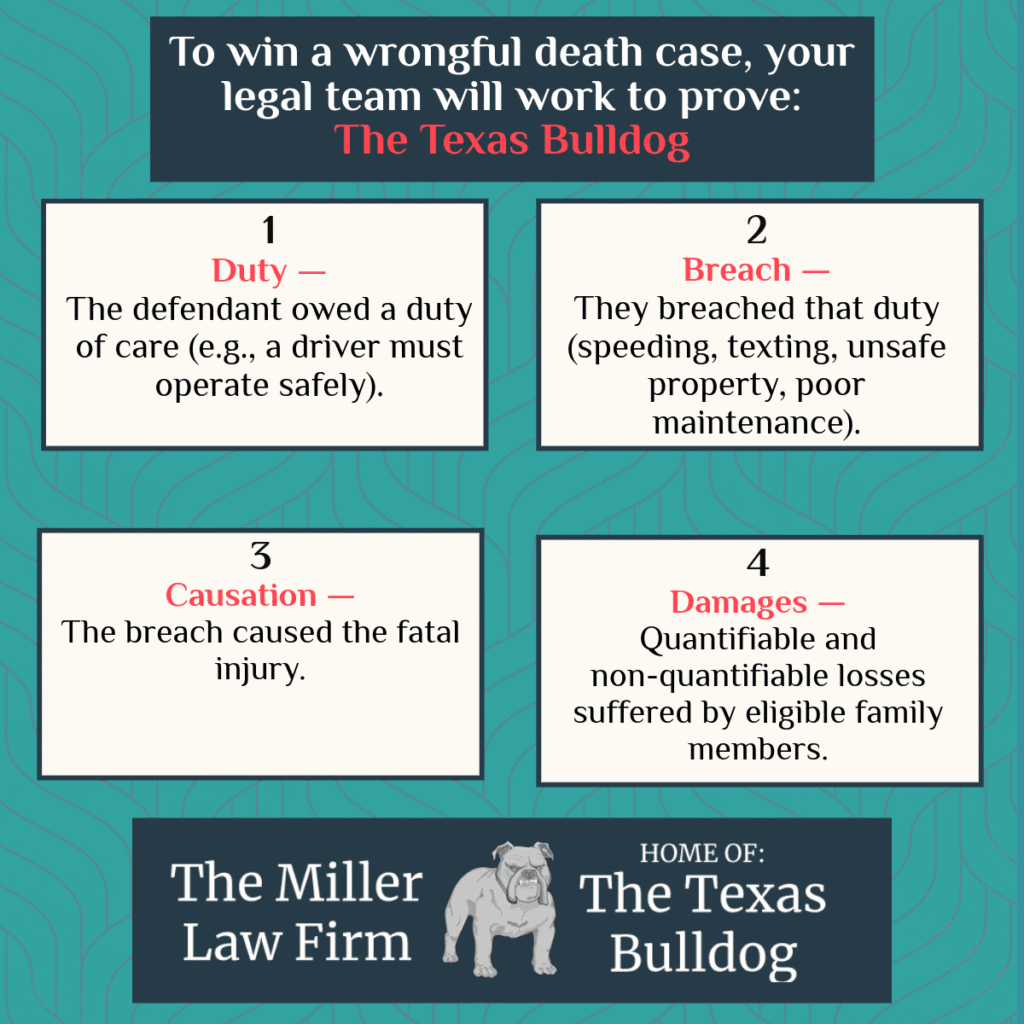
To win a wrongful death case, your legal team will work to prove:
- Duty — The defendant owed a duty of care (e.g., a driver must operate safely).
- Breach — They breached that duty (speeding, texting, unsafe property, poor maintenance).
- Causation — The breach caused the fatal injury.
- Damages — Quantifiable and non-quantifiable losses suffered by eligible family members.
Because insurers fight hard on causation and damages, your lawyer should gather independent evidence early: crash reconstruction, vehicle data, maintenance logs, employer policies, black-box downloads, surveillance, toxicology reports, cell phone records, and testimony from experts (medical, economic, vocational).
If the loss arose from a traffic collision, the background articles below can sharpen your understanding of liability and preventable risks:
How Long Do You Have to File? (Texas Statute of Limitations)
Texas generally provides two years from the date of death to file a wrongful death lawsuit. Exceptions can apply (for example, when the defendant is a government entity or under certain discovery-rule circumstances). Missing the deadline can bar recovery. Talk to a wrongful death attorney immediately so evidence is preserved and your rights remain protected.
The Texas Bulldog Method: How We Build Your Case
We do not accept the insurer’s first story. We build (and pressure-test) the case from the ground up.
Early Action & Evidence Lockdown
- Preserve vehicles, black-box data, and site evidence
- Demand letters to stop spoliation
- Rapid witness interviews before memories fade
Independent Investigation
- Collision reconstruction and visibility analyses
- Company policy, training, and supervision audits (for commercial cases)
- Past violations, maintenance records, and hours-of-service review
Damages Modeling
- Economist calculations for lost earnings and benefits
- Vocational analysis for career trajectory
- Life-care and medical expense audits for final bills
Litigation Readiness
- Written discovery, depositions, motions practice
- Mediation and negotiation with a trial-ready posture
- Jury selection strategy and demonstrative evidence preparation
If your case touches rideshare or commercial carriers, visit these resources:
Common Insurance Defenses (and How We Counter Them)
“No negligence.”
Insurers claim it was an “unavoidable accident.” We counter with reconstruction, time-distance studies, and human-factors analysis.
“Comparative fault.”
Texas proportionally reduces damages if the decedent was partly at fault (and bars recovery over 50% fault). We fight to minimize any unfair fault assignment with objective data and expert testimony.
“No causation.”
They’ll argue the fatal outcome was unrelated to the breach (e.g., pre-existing conditions). We use medical experts to bridge causation.
“Damages are speculative.”
We document everything—earnings history, career trajectory, benefits, and the lived experience of the family’s loss.
If the defense tries to delay or deny, learn how we handle insurers in depth:
Settlement vs. Trial: What Families Should Expect
Most cases settle when insurers realize trial is a risk they don’t want. However, the best settlements come from strong trial preparation. We keep families informed, share options at every fork in the road, and never push a settlement that undervalues your loss. When trial is the right move, we aim to present your loved one’s story with clarity, compassion, and persuasive evidence that resonates with jurors.
To understand fee structures and costs, this explainer may help:
How Long Will a Wrongful Death Case Take?
Timelines vary widely. Factors include dispute over liability, volume of evidence, number of defendants, insurance coverage disputes, and the court’s docket. Some matters resolve in months; complex cases can take longer. Our priority is getting it right—compiling the full measure of damages and pushing the insurer toward a maximum-value resolution.
What to Do Right Now (Step-by-Step)
1) Secure important documents.
Collect the crash report, medical records, funeral receipts, employment and benefits documents, and any photos or videos.
2) Avoid recorded statements.
Insurers may reach out quickly. Do not provide statements or sign anything without counsel.
3) Preserve evidence.
Vehicles, black-box data, and surveillance footage can disappear. We send spoliation letters and move fast.
4) Get a free legal review.
Speak with a wrongful death attorney to confirm next steps, timelines, and evidence strategy.
Curious about related topics? You might also read:
Why Choose The Texas Bulldog
- Proven results mindset with investigation that starts day one
- Direct communication so you always know what’s happening
- Trial-ready posture to drive settlement leverage
- Local insight into Houston roads, carriers, and courts
When you’re ready, we’re here to shoulder the legal burden so your family can focus on healing.
What Our Clients Say
⭐⭐⭐⭐⭐
“The relief that ALL my medical bills were paid and I still walked away with money made it all worth it. Erica and Julia were awesome!” — O’Neal T.
“Mr. Miller and his staff were amazing. There was never a time that he didn’t take my calls and answer my questions.” — Gwen Black
“I had an excellent experience working with the Miller Law Firm and their team. From the very beginning, they were professional, knowledgeable, and genuinely cared about my case.” — Mekala Schultz
Quick Comparison: Wrongful Death vs. Survival Action
| Feature | Wrongful Death Claim | Survival Action |
|---|---|---|
| Who recovers? | Spouse, children, parents | Decedent’s estate |
| What’s compensated? | Family’s losses (companionship, guidance, earnings the family lost) | Damages the decedent could have recovered if they had lived (pain, medical, lost wages up to death) |
| Purpose | Compensate the family | Compensate the estate (then distributed per will/intestacy) |
| Can both be filed? | Yes, when applicable | Yes, coordinated litigation is strategic |
An experienced wrongful death attorney evaluates both tracks and aligns them for the strongest overall recovery.
People Also Ask (FAQ)
1) What qualifies as a wrongful death case?
Any death caused by another’s negligence or wrongful act—such as a reckless driver, unsafe property condition, or dangerous product—may qualify.
2) Who can sue for wrongful death in Texas?
The spouse, children, and parents can sue; if they don’t, the estate may file in certain circumstances.
3) How long do I have to file?
Generally two years from the date of death, though exceptions can apply. Act quickly to preserve evidence.
4) What damages can we recover?
Medical and funeral expenses, lost income and benefits, loss of companionship, mental anguish, and in some cases exemplary damages.
5) Do we have to go to trial?
Not always. Many cases settle, but trial readiness improves settlement value.
6) How are lawyer fees handled?
We typically use a contingency fee, meaning you pay nothing upfront. Learn more: Car Accident Lawyer Fees.
7) Can a company be held responsible for an employee’s conduct?
Yes. Under certain legal doctrines, employers can be liable for negligent employees acting within the scope of employment.
8) What if my loved one was partly at fault?
Texas uses comparative fault. Recovery may be reduced by fault percentage and is barred over 50%.
9) What if the insurer denies our claim?
You still have options through litigation.
10) How much is our case worth?
Valuation depends on liability strength, insurance limits, earnings history, age/health, and non-economic loss. We model damages with economists to pursue full value.
Contact The Miller Law Firm – home of The Texas Bulldog

We know that choosing the right wrongful death attorney is a decision that impacts your family’s future. Compassion, experience, and relentless advocacy are at the heart of everything we do. Don’t just take our word for it — hear directly from Houston families we’ve helped. Check out our 100+⭐ ⭐ ⭐ ⭐ ⭐ 5 Star Reviews on Google! Call us now for a Free Consultation at 713-572-3333 or fill out our contact form today.