
Can You Cancel a Personal Injury Lawyer Contract in Texas?
You generally have the right to end your relationship with a personal injury lawyer, but attorney fees, case deadlines and the terms of your contract can affect what happens next.
Yes, You Can Usually Cancel the Contract
In most situations, a client can fire a personal injury lawyer and hire a different attorney, even after the claim or lawsuit has already started.
However, your former lawyer may claim compensation for work already performed, and changing attorneys can affect the timing and handling of your case. Your rights may be different if the contract was obtained through pressure, deception or illegal solicitation known as barratry .
Did You Know?
A contingency-fee contract does not mean you are permanently locked into working with that lawyer.
You still have the right to choose who represents you. The more complicated question is whether the former lawyer may later seek part of the attorney fee if money is recovered in your case.
Texas Bulldog Tip
Do not cancel your attorney agreement or sign with a new firm until you understand the possible fee consequences, upcoming deadlines and how your case file will be transferred.
Do You Have the Right to Cancel a Personal Injury Lawyer Contract?
Yes. Under Texas professional-conduct rules, a client generally has the power to discharge a lawyer at any time, with or without a specific reason.
That means a contingency-fee agreement does not force you to remain represented by a lawyer you no longer trust. You may end the attorney-client relationship and choose another lawyer to handle your personal injury claim.
However, canceling the relationship does not automatically erase every part of the contract. The former lawyer may claim payment for services already performed or expenses advanced, depending on the agreement and the circumstances surrounding the termination.
Canceling the Contract and Owing Fees Are Different Questions
You can generally choose to end the attorney-client relationship.
The lawyer may still claim compensation for work completed before termination.
A new lawyer should review the contract and any claimed attorney's lien before taking over the case.
Did You Know?
Your right to choose your lawyer is not eliminated just because you signed a contingency-fee agreement. A fee contract may address what happens financially after termination, but it generally cannot take away your ability to discharge the lawyer.
Important: Do Not Ignore an Active Lawsuit
If a lawsuit has already been filed, changing lawyers may require a formal substitution or court-approved withdrawal. Deadlines, hearings and discovery obligations continue while the change is being handled, so make sure responsibility for the case is clearly transferred.
Why Do People Cancel Their Personal Injury Lawyer?
Most clients don't switch lawyers because they lose patience—they switch because they lose confidence. If communication breaks down or you no longer trust your attorney to protect your interests, it may be time to explore your options.
Poor Communication
Weeks go by without updates. Phone calls aren't returned. Emails are ignored. While every case has periods of waiting, you should never feel completely left in the dark about what's happening.
Lack of Confidence
You may feel your lawyer isn't taking your injuries seriously, isn't investigating your case, or accepted the insurance company's position without putting up a fight.
You Were Pressured Into Signing
Some accident victims sign a contract while they're overwhelmed, in pain, or still recovering. Others are contacted by someone connected to a lawyer before they've even had time to consider their options.
💡 Did You Know?
If someone contacted you in the hospital, at the accident scene, by phone, text message, or through another person encouraging you to hire a specific lawyer, that may raise questions about illegal solicitation, also known as barratry. If your contract resulted from unlawful solicitation, you may have additional legal rights beyond simply changing attorneys.
Texas Bulldog Tip
Feeling frustrated with your lawyer doesn't automatically mean you should switch—but feeling ignored, misled, or pressured should never be dismissed. Before making a decision, understand your rights and have another experienced attorney review your situation.
What Happens After You Cancel Your Lawyer?
Ending your attorney-client relationship doesn't end your injury claim. Your case continues, but there are several important steps that usually happen behind the scenes.
Your Former Lawyer Withdraws
If a lawsuit has already been filed, your attorney may need to formally withdraw from the case. If no lawsuit has been filed, the transition is often much simpler and involves transferring your file to your new attorney.
Your Case File Is Transferred
Medical records, accident reports, photographs, correspondence, insurance information and other case documents are typically provided to your new attorney so work can continue without starting over.
Your New Lawyer Takes Over
Your new attorney reviews the file, evaluates what has already been done, identifies any upcoming deadlines and develops a strategy for moving your case forward.
What Usually Changes?
| Your Injury Claim | Continues |
| Insurance Negotiations | Continue with new lawyer |
| Medical Treatment | Usually stays the same |
| Court Deadlines | Still apply |
| Attorney Fees | May need to be resolved later |
⚠️ Common Mistake
Some people stop communicating with their current lawyer before hiring a new one. That can create confusion and unnecessary delays. Whenever possible, have your new attorney coordinate the transition and request your case file on your behalf.
Will You Have to Pay Two Lawyers?
This is one of the biggest concerns people have when changing attorneys. Fortunately, the answer is usually much simpler than most people expect.
Most personal injury lawyers work on a contingency fee, meaning they only receive a fee if money is recovered for you. If you change lawyers before your case ends, that does not automatically mean you'll pay two separate contingency fees.
Instead, the attorneys often resolve how the fee is divided based on the work each performed and the circumstances of the case. Every situation is different, so your new attorney should review your existing contract before advising you how the transition may affect attorney's fees.
| Situation | What Usually Happens |
|---|---|
| You change lawyers early in the case | The new lawyer typically continues the case, while any fee issues are resolved between the attorneys or later in the case. |
| A lawsuit has already been filed | The court may need to approve the withdrawal of your previous attorney before the new lawyer officially appears in the case. |
| Your former lawyer claims attorney's fees | The amount, if any, depends on the contract, the work performed and applicable Texas law. |
| Your case results in no recovery | Contingency-fee agreements generally provide that attorney's fees are only earned if money is recovered, although every contract should be reviewed individually. |
🐾 Texas Bulldog Tip
Before changing attorneys, ask your new lawyer to explain exactly how attorney's fees may be handled in your specific case. An experienced lawyer can often answer these questions before you sign anything.
⚠️ Common Mistake
Don't assume you can't switch lawyers because someone told you that you'll "owe two attorneys." Every case is different, and many people change lawyers without paying two full contingency fees.
Should You Stay With Your Current Lawyer or Switch?
Every case is different, but this comparison highlights some of the factors people commonly consider when deciding whether to remain with their current attorney or seek new representation.
| Stay With Your Current Lawyer | Change to a New Lawyer |
|---|---|
| Continue with your current legal strategy. | Receive a fresh review of your case and legal options. |
| No transition process. | Your new lawyer typically coordinates the file transfer. |
| Communication stays the same. | Opportunity for improved communication and responsiveness. |
| Current fee agreement remains in place. | Any fee issues are typically addressed during the transition. |
| May be the right choice if you're confident in your attorney. | May be worth considering if you've lost confidence or believe you were improperly solicited. |
What If You Signed Because of Illegal Solicitation?
Not every lawyer contract is obtained the same way. If someone pressured you to hire a lawyer after your accident, Texas law may provide protections that don't apply to ordinary attorney-client agreements.
After a serious accident, victims are often overwhelmed, injured and focused on their medical care—not researching lawyers. Unfortunately, some people take advantage of that situation by contacting accident victims before they've had a chance to make an informed decision.
Texas prohibits certain types of attorney solicitation, commonly known as barratry. If a lawyer or someone working on their behalf illegally solicited your case, the contract you signed may be subject to additional legal challenges.
Every situation is unique, but if you believe someone approached you at the hospital, contacted you after your accident, or pressured you into signing with a particular law firm, you should have your contract reviewed before assuming you're stuck with that attorney.
Possible Warning Signs
Someone came to the hospital or your home after the accident.
A tow truck driver, medical provider or another third party recommended one specific lawyer.
You were encouraged to sign paperwork before fully understanding what it was.
You felt pressured to sign immediately instead of having time to compare law firms.
Learn More About Barratry
If you think your lawyer was obtained through illegal solicitation, we've created a complete resource center explaining how barratry works, common warning signs and what your rights may be under Texas law.
Visit the Texas Barratry Resource Hub →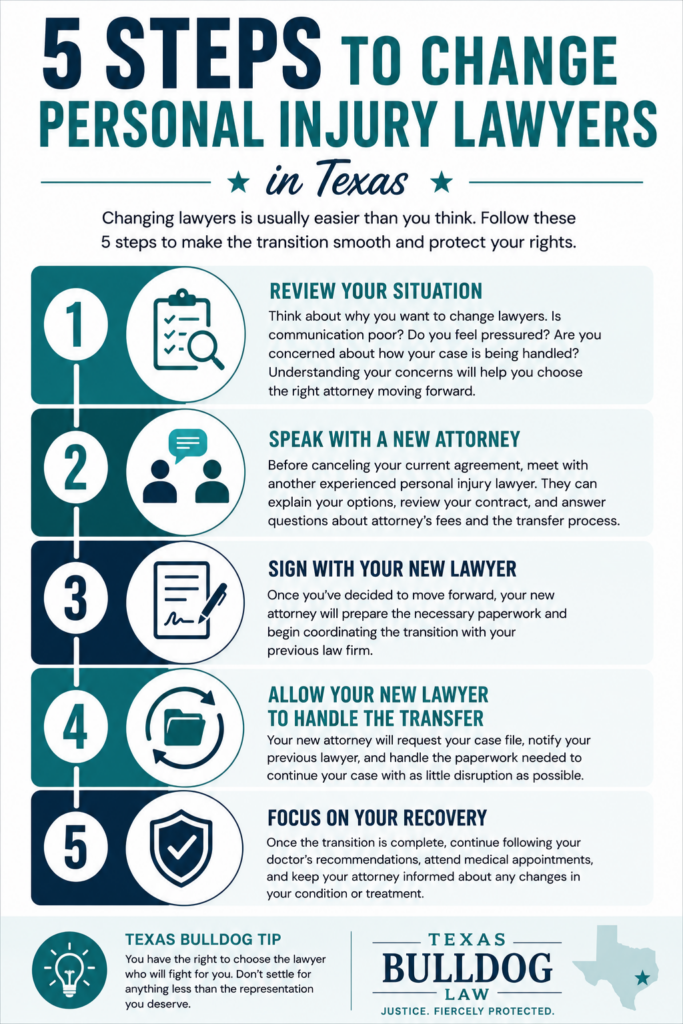
How to Change Personal Injury Lawyers in Texas
Switching attorneys is usually more straightforward than people expect. These five steps can help protect your case and make the transition as smooth as possible.
Review Your Current Situation
Identify why you want to change lawyers. Consider whether communication has broken down, whether you have lost confidence in the legal strategy, or whether you believe you were pressured into signing the agreement.
Speak With Another Attorney
Before ending your current agreement, consult another experienced personal injury lawyer. The new attorney can review your contract, explain possible fee issues and identify any deadlines that must be protected.
Hire Your New Lawyer
Once you decide to move forward, carefully review the new contingency-fee agreement and ask questions before signing. Make sure you understand who will handle your case and how the transition will work.
Transfer the Case File
Your new lawyer can usually notify the former firm, request your records and coordinate the substitution of counsel if a lawsuit has already been filed. This helps reduce confusion and unnecessary delays.
Keep Your Case Moving
Continue attending medical appointments, following treatment recommendations and preserving evidence. Changing lawyers does not pause your responsibilities or extend important filing deadlines.
⚠️ Do Not Cancel Before Checking Deadlines
Before ending the relationship, confirm whether a lawsuit has been filed, whether any hearings are scheduled and whether the statute of limitations is approaching. Your new attorney should understand the current status of the case before the transition begins.
Common Questions About Canceling a Personal Injury Lawyer
Still have questions? Here are answers to some of the most common concerns people have before changing personal injury attorneys in Texas.
Can I fire my personal injury lawyer at any time?
Generally, yes. Texas clients usually have the right to end the attorney-client relationship at any point. However, your former lawyer may still have rights regarding fees or reimbursement for work already performed depending on the circumstances.
Will changing lawyers delay my case?
It can cause a short transition while your file is transferred, but many cases continue with minimal interruption. Your new attorney can often coordinate the transfer to help keep your claim moving forward.
Do I have to tell my current lawyer before talking to another attorney?
No. Many people speak with another attorney first to understand their options before deciding whether changing lawyers is the right choice.
What if I signed the contract in the hospital?
If you believe you were pressured into signing or someone illegally solicited your case while you were recovering from an accident, you may have additional rights. An attorney can review how the contract was obtained and explain your legal options.
Can my new lawyer get my case file for me?
Yes. In many situations, your new attorney can request your case file directly from your previous lawyer and handle much of the transition on your behalf.
What should I do if I think I was a victim of barratry?
Don't assume you're stuck with the lawyer you hired. If you believe someone illegally solicited your case, consider speaking with an attorney experienced in Texas barratry claims to understand your rights and whether the circumstances surrounding your contract may affect your legal options.
Related Resources
Whether you're researching your legal rights or deciding whether to change attorneys, these resources can help you make an informed decision.
Texas Barratry Resource Hub
Learn how illegal lawyer solicitation works, how to recognize it, and what your legal rights may be under Texas law.
10 Signs You May Be a Victim of Barratry
Discover the most common warning signs that someone may have illegally solicited your personal injury case after an accident.
Meet Adam H. Miller
Learn more about Adam H. Miller, founder of The Miller Law Firm, and his work protecting accident victims from unethical legal practices, including barratry.
You Should Never Feel Trapped by Your Lawyer
If you're unhappy with your current attorney, have questions about your contingency fee agreement, or believe you were illegally solicited after your accident, you deserve to understand your legal rights before making a decision. Our team can review your situation, explain your options, and answer your questions during a free, no-obligation consultation.
Free Consultation
Discuss your current legal situation with an experienced Texas personal injury attorney.
Contract Review
We'll help you understand your attorney agreement and explain what options may be available.
The Texas Bulldog
We're committed to protecting accident victims and standing up against unethical legal practices.