
Texas Guide: Should You Give a Recorded Statement to the Insurance Company After a Car Accident?
Quick Answer
If you’ve been injured in a Texas car accident, you are generally not required to give a recorded statement to the other driver’s insurance company. In fact, doing so without understanding your rights could unintentionally harm your claim. Insurance adjusters often request recorded statements early in the claims process, and even innocent comments can be taken out of context or used to dispute liability, minimize your injuries, or reduce the value of your claim.
Your own insurance company may require your cooperation under the terms of your policy, but that does not mean you should answer every question without understanding the potential consequences. Before providing a recorded statement, consider speaking with an experienced Texas personal injury attorney. If you’re unsure what to do immediately after a crash, our guide on what to do after a Texas car accident can help you understand the next steps while protecting your rights and your claim.
Key Takeaways
- You are usually not required to give a recorded statement to the other driver’s insurance company.
- Your own insurance company may require reasonable cooperation under your policy.
- Insurance adjusters are trained to ask questions that may reduce or deny claims.
- Even honest mistakes or guesses can negatively affect your injury claim.
- Speaking with a Texas personal injury attorney before giving a recorded statement can help protect your rights.
This guide reflects current Texas personal injury laws and insurance claim practices. We review our legal guides regularly to help ensure the information remains accurate and up to date.
Quick Answers to Common Questions
Can I refuse to give a recorded statement to the other driver’s insurance company?
Yes. In most Texas car accident cases, you are not legally required to provide a recorded statement to the other driver’s insurance company.
Can a recorded statement hurt my injury claim?
Yes. Even honest mistakes, guesses, or comments about your injuries can be used by an insurance company to dispute liability or reduce the value of your claim.
Should I talk to an insurance adjuster before hiring a lawyer?
If you’ve suffered injuries, liability is disputed, or the insurance company has requested a recorded statement, speaking with an attorney first can help protect your legal rights and your claim.
📌 At a Glance
- Required to give a statement to the other driver’s insurer? ❌ Usually no.
- Required to cooperate with your own insurer? ⚠️ Often yes, depending on your policy.
- Should you guess if you’re unsure? ❌ Never.
- Can you ask to call back? ✔️ Yes.
- Should you speak with a lawyer first? ✔️ Often a smart idea if you’ve been injured.
Recorded Statement: Quick Comparison
| Situation | Recommended Approach |
|---|---|
| The other driver’s insurance company requests a recorded statement | ❌ You are generally not required to provide one. |
| Your own insurance company requests a recorded statement | ⚠️ Your policy may require reasonable cooperation. |
| You are unsure what to say | ✔️ Consider speaking with a lawyer first. |
| You are still receiving medical treatment | ✔️ Avoid discussing the full extent of your injuries until they are known. |
| You are asked to guess about speed, fault, or injuries | ❌ Never guess or speculate. |
Table of Contents
- Why Insurance Companies Ask for Recorded Statements
- Do You Have to Give a Recorded Statement?
- How Your Words Can Be Used Against You
- Common Questions Insurance Adjusters Ask
- What Should You Say Instead?
- Can Refusing a Recorded Statement Hurt Your Claim?
- What If You Already Gave a Recorded Statement?
- Real-World Scenarios
- Common Insurance Myths vs. Reality
- Red Flags to Watch For When an Insurance Company Calls
- Questions You Should Ask the Insurance Adjuster
- When Should You Contact a Lawyer?
- Frequently Asked Questions
Why Insurance Companies Ask for Recorded Statements
After a Texas car accident, it’s common for an insurance adjuster to contact you within days—or sometimes even hours—and ask if they can record your statement. They may tell you it’s simply part of the claims process or that they “just need a few details” to move your claim forward.
While there are legitimate reasons insurance companies investigate accidents, it’s important to remember that adjusters work for the insurance company—not for you. Their job is to gather information, evaluate the claim, and protect the company’s financial interests.
A recorded statement creates a permanent record of everything you say. If your injuries worsen over time, you accidentally misspeak, or you guess about what happened, those statements could later be compared to medical records, witness testimony, police reports, or other evidence. In some cases, the insurance company may use inconsistencies to question your credibility or argue that your injuries are less serious than you claim.
That doesn’t mean every adjuster is trying to trick you, but it does mean you should understand why they’re requesting a recorded statement before agreeing to provide one.
Key Point
A recorded statement isn’t just a conversation—it’s evidence. Once your words are recorded, the insurance company may rely on them throughout the claims process, making it important to answer carefully and avoid guessing or speculating.
Did You Know?
Many people don’t realize that some injuries, including whiplash, concussions, and soft tissue injuries, may not fully develop until hours or even days after a crash. Saying “I’m fine” immediately after an accident could later be used to question the seriousness of your injuries.
Do You Have to Give a Recorded Statement?
One of the first questions many accident victims ask is whether they are legally required to give a recorded statement after a Texas car accident. The answer depends on which insurance company is requesting the statement.
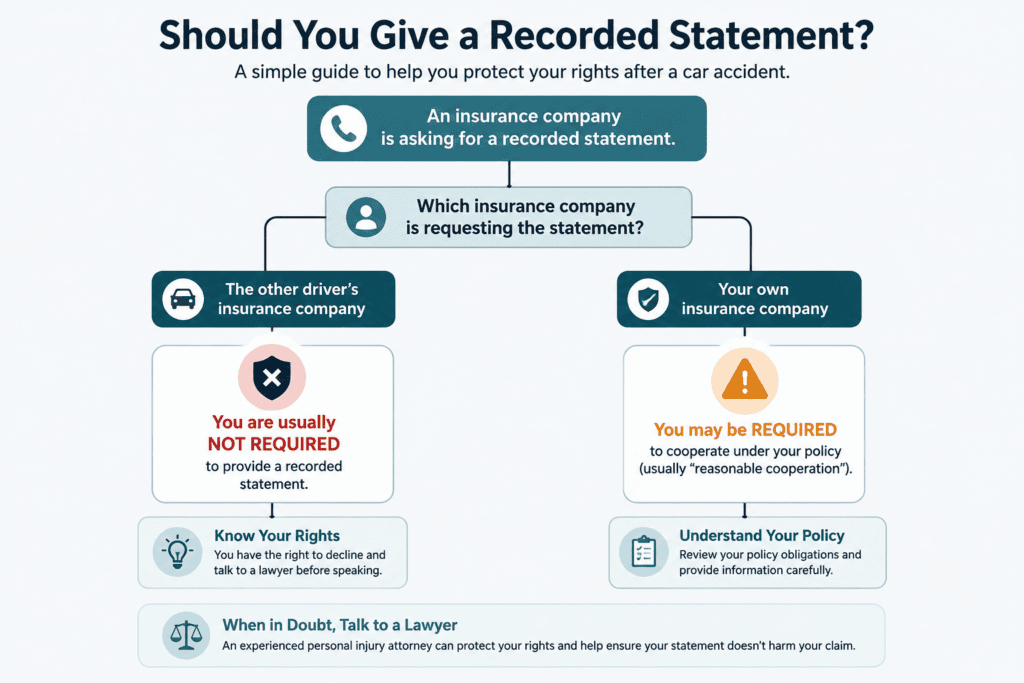
In most cases, you are not required to provide a recorded statement to the other driver’s insurance company. However, if you are filing a claim with your own insurance company, your policy may require you to cooperate with its investigation. Even then, you should understand your rights before answering detailed questions or agreeing to have your conversation recorded.
If you’re unsure what your insurance policy requires or which coverages may apply after an accident, our guide to Texas auto insurance coverage explains the different types of insurance and how they may affect your claim.
⚖️ Texas Law
Texas law generally does not require you to provide a recorded statement to the other driver’s insurance company. However, if you are making a claim under your own insurance policy, your insurer may require reasonable cooperation under the terms of your policy. Every situation is different, so it’s important to understand your rights before providing a recorded statement.
| Question | Other Driver’s Insurance Company | Your Own Insurance Company |
|---|---|---|
| Are you usually required to give a recorded statement? | ❌ No | ⚠️ Sometimes, depending on your policy. |
| Can your words be used against you? | ✔️ Yes | ✔️ Yes |
| Should you guess or speculate? | ❌ Never | ❌ Never |
| Should you admit fault? | ❌ No | ❌ No |
| Should you consider speaking with a lawyer first? | ✔️ Yes | ✔️ In many injury cases, yes. |
Although your own insurance company may require cooperation under your policy, that doesn’t mean you have to answer every question immediately or without understanding the potential consequences. If you’ve suffered serious injuries or fault is disputed, consulting a Texas personal injury attorney before providing a recorded statement can help you avoid mistakes that may affect your claim.
If the at-fault driver doesn’t have enough insurance—or doesn’t have insurance at all—your own uninsured and underinsured motorist coverage may become an important source of compensation. Understanding how this coverage works before speaking with your insurance company can help you make informed decisions about your claim.
How Your Words Can Be Used Against You
Many people believe that if they’re telling the truth, they have nothing to worry about when giving a recorded statement. While honesty is always important, the issue isn’t whether you’re truthful—it’s whether your words can be misunderstood, taken out of context, or compared against other evidence later in your claim.
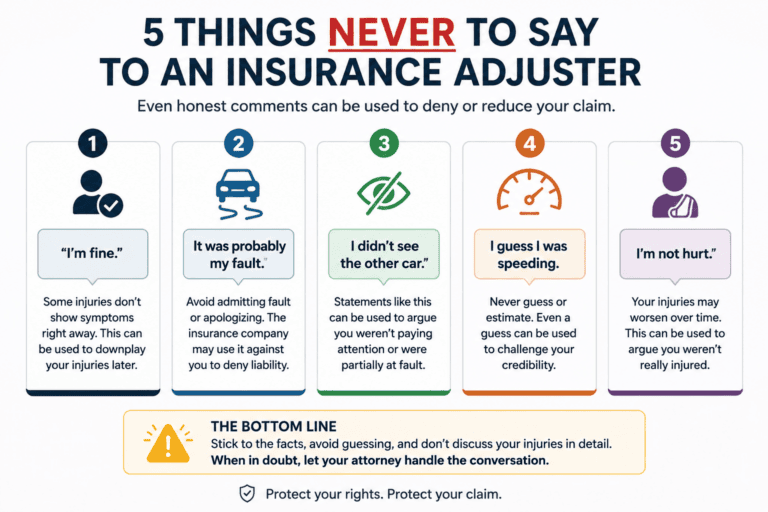
Insurance adjusters are trained to ask detailed questions about the accident, your injuries, and what happened before and after the crash. If you guess about your speed, estimate distances, minimize your pain, or make an inaccurate statement, those comments may later be used to challenge your credibility or reduce the value of your claim.
If the insurance company argues that your own statements show you were partially responsible for the accident, understanding Texas comparative fault laws can help you better understand how shared responsibility may affect your ability to recover compensation.
It’s also common for injuries to worsen over time. Immediately after an accident, you may believe you’re only sore or that you’ll feel better in a day or two. However, conditions such as whiplash, concussions, back injuries, and soft tissue damage often become more noticeable after the initial shock wears off.
🔴 Common Mistake
Many accident victims try to be helpful by answering every question from the insurance adjuster—even when they don’t know the answer. Guessing about speed, distance, fault, or the extent of your injuries can create inconsistencies that may later be used against you.
Examples of Statements That Can Hurt Your Claim
| ❌ What You Say | ⚠️ How the Insurance Company May Interpret It |
|---|---|
| “I’m fine.” | The insurance company may argue that you weren’t seriously injured. |
| “I didn’t really see the other car.” | They may argue you weren’t paying attention before the crash. |
| “Maybe I was going a little fast.” | They may claim you were partially responsible for the accident. |
| “I guess my neck just feels a little sore.” | They may minimize the seriousness of your injuries. |
| “I’m not sure exactly what happened.” | They may question your credibility or argue your memory isn’t reliable. |
Common Questions Insurance Adjusters Ask
Insurance adjusters often ask questions that seem simple or routine. While many are legitimate, your answers may later be compared with medical records, witness statements, police reports, and other evidence. That’s why it’s important to answer truthfully without guessing, speculating, or volunteering unnecessary information.
Below are some of the most common questions you may be asked after a Texas car accident and why they’re important.
| Question You May Be Asked | Why They’re Asking |
|---|---|
| How are you feeling today? | To see whether you minimize or downplay your injuries. |
| Can you describe exactly what happened? | To compare your version of events with other evidence. |
| How fast were you driving? | To determine whether they can argue you were partially at fault. |
| Did you see the other vehicle before the crash? | To evaluate whether they can argue you failed to avoid the collision. |
| Have you ever injured this part of your body before? | To determine whether they can attribute your injuries to a pre-existing condition. |
| Are you represented by an attorney? | To understand how future communications and claim negotiations will be handled. |
💡 Pro Tip
Take your time before answering any question from an insurance adjuster. If you don’t know the answer or aren’t certain, it’s better to say so than to guess. A recorded statement becomes part of your claim file, and inaccurate information may be difficult to correct later.
Remember, there’s a difference between answering questions honestly and feeling pressured to provide more information than necessary. Sticking to the facts and avoiding speculation can help protect your claim while the investigation moves forward.
What Should You Say Instead?
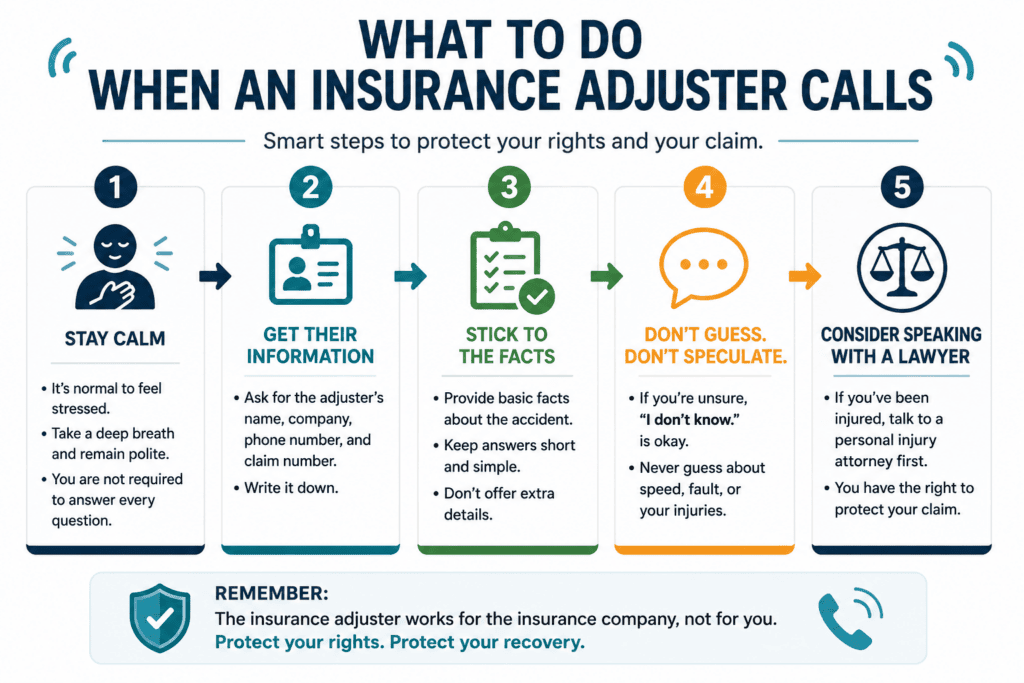
If an insurance adjuster contacts you after a Texas car accident, it’s important to remain calm and stick to the facts. You don’t have to know every answer immediately, and you should never feel pressured to guess or speculate about what happened.
Providing accurate information is important, but so is protecting your rights. If you don’t know the answer to a question or your injuries are still being evaluated, it’s perfectly acceptable to say so.
📋 Checklist: Before Giving a Recorded Statement
- ✔️ Confirm which insurance company is calling.
- ✔️ Ask for the adjuster’s name, phone number, and claim number.
- ✔️ Stick to facts you know are accurate.
- ✔️ Don’t guess about speed, distance, or fault.
- ✔️ Don’t minimize or exaggerate your injuries.
- ✔️ Don’t admit fault or apologize for the accident.
- ✔️ If you’re unsure how to answer, tell the adjuster you’ll call back after reviewing your options.
- ✔️ Consider speaking with a Texas personal injury attorney before providing a recorded statement.
Helpful Responses You Can Use
If you’re caught off guard by an insurance adjuster’s call, you don’t have to answer every question immediately. Here are a few examples of responses that are both polite and appropriate:
| Instead of Saying… | Consider Saying… |
|---|---|
| “I guess I was going about 40 mph.” | “I’m not comfortable estimating my speed.” |
| “I’m fine.” | “I’m still being evaluated and don’t yet know the full extent of my injuries.” |
| “I don’t think I need a lawyer.” | “I’d like time to review my options before making any decisions.” |
| Answering questions you’re unsure about. | “I’m not certain, so I don’t want to guess.” |
Remember, being polite doesn’t mean you have to answer every question immediately. Taking time to understand your rights and seek legal advice when necessary can help you avoid mistakes that may affect your claim.
Can Refusing a Recorded Statement Hurt Your Claim?
Many accident victims worry that refusing a recorded statement will automatically hurt their claim or make them look uncooperative. In most cases, that’s not true—especially when the request comes from the other driver’s insurance company.
If you’re dealing with the at-fault driver’s insurer, you are generally under no legal obligation to provide a recorded statement. The insurance company can still investigate the accident using police reports, photographs, witness statements, vehicle damage, medical records, and other available evidence. Because Texas is an at-fault state, not a no-fault state, the other insurer is looking for evidence of who was to blame, and your own words can become part of it.
The situation may be different if you’re making a claim under your own insurance policy. Many policies require policyholders to cooperate with the claims process, and refusing to do so could affect certain coverages. If you’re unsure about your obligations, it’s best to review your policy or speak with an attorney before making a decision.
💡 Did You Know?
Insurance companies routinely investigate claims without recorded statements. Police reports, crash scene photographs, medical records, witness testimony, vehicle damage, and electronic data may all be used to evaluate what happened after a Texas car accident.
When You Should Be Especially Careful
Consider speaking with a Texas personal injury attorney before giving a recorded statement if:
- Your injuries are serious or still being evaluated.
- Fault for the accident is disputed.
- The accident involved an 18-wheeler or commercial vehicle.
- Multiple vehicles were involved.
- The insurance company is pressuring you to give a statement immediately.
- You’ve already received medical treatment or expect ongoing care.
Every accident is different. Understanding your rights before providing a recorded statement can help you avoid unnecessary risks while protecting your ability to pursue fair compensation.
What If You Already Gave a Recorded Statement?
If you’ve already provided a recorded statement to an insurance company, don’t assume you’ve ruined your case. Many accident victims agree to a recorded interview before they fully understand their rights or realize they may have suffered serious injuries.
While an insurance company may review your recorded statement during its investigation, it is only one piece of evidence. Medical records, police reports, witness statements, photographs, video footage, and expert opinions may also play an important role in determining liability and the value of your claim. Medical records are often some of the most important evidence in a personal injury case. If you’re wondering how medical bills may affect your settlement, our guide to recovering medical expenses in Texas explains the state’s paid vs. incurred rule and what it could mean for your claim.
If you realize that you misspoke, guessed about something, or answered a question before you had all of the facts, avoid trying to “fix” the situation by giving another recorded statement on your own. Instead, consider speaking with an experienced Texas personal injury attorney who can review your case and advise you on the best next steps.
💬 Why This Matters
A recorded statement is important, but it rarely determines the outcome of an injury claim by itself. Insurance companies must also consider the full body of evidence, including your medical treatment, the facts of the accident, and any supporting documentation.
What You Should Do Next
- Continue following your doctor’s treatment recommendations.
- Save any medical bills, receipts, photographs, and other evidence related to the accident.
- Avoid giving additional recorded statements unless you understand your rights.
- Keep copies of any letters, emails, or messages from the insurance company.
- If you’re concerned about something you said, speak with a Texas personal injury attorney before responding to additional requests from the insurance company.
Even if you’ve already given a recorded statement, it may still be possible to pursue fair compensation. Every case is different, and the impact of a recorded statement depends on the specific facts of your accident and the evidence available. If you’ve received treatment after your accident, it’s also important to understand how hospital liens in Texas may affect your settlement and what steps you can take to protect your recovery.
Real-World Scenarios
Every car accident is different, which means there isn’t a one-size-fits-all answer to whether you should provide a recorded statement. Here are some common situations Texas drivers face after an accident.
What if I was rear-ended?
Even if the other driver appears to be clearly at fault, it’s still wise to be cautious when speaking with the insurance company. Avoid discussing injuries in detail until you’ve received a medical evaluation, and don’t assume liability will never be disputed.
What if I think the accident was partly my fault?
Don’t assume you’re legally responsible based on your own opinion. Texas accident investigations often involve multiple pieces of evidence, and fault may not be as straightforward as it first appears. Let the facts—not guesses or assumptions—determine liability.
What if an 18-wheeler was involved?
Commercial truck accidents often involve multiple insurance companies, corporate investigators, and more complex evidence. If you’ve been involved in a truck accident, consider speaking with an attorney before providing any recorded statement.
What if I don’t feel injured yet?
Some injuries, including whiplash, concussions, and soft tissue injuries, may not fully develop until hours or days after a crash. Be careful about telling an insurance adjuster you’re “fine” before you know the full extent of your injuries.
What if the adjuster says, “This will only take five minutes”?
Don’t feel pressured to make an immediate decision. It’s perfectly reasonable to ask for the adjuster’s contact information and return the call after you’ve had time to consider your options or seek legal advice.
What if they call while I’m still at the accident scene?
Your priority should be your safety, reporting the accident, and seeking medical attention if needed. You don’t have to provide a recorded statement while you’re still dealing with the immediate aftermath of a crash.
These examples illustrate why it’s important to evaluate your specific circumstances before agreeing to a recorded statement. What may be appropriate in one case may not be appropriate in another.
Insurance Myths vs. Reality
After a Texas car accident, it’s easy to receive conflicting advice from friends, family, social media, or even the insurance company. Understanding what’s true—and what’s not—can help you make informed decisions about your claim.
| ❌ Myth | ✅ Reality |
|---|---|
| “I have to give a recorded statement.” | In most cases, you are not legally required to provide a recorded statement to the other driver’s insurance company. |
| “If I refuse, they’ll automatically deny my claim.” | Insurance companies can investigate accidents using many other forms of evidence. |
| “Saying I’m okay can’t hurt my case.” | Some injuries don’t appear immediately, and those comments may later be used to challenge your claim. |
| “The insurance adjuster is on my side.” | Adjusters work for the insurance company and are responsible for evaluating claims on its behalf. |
| “Once I give a recorded statement, my case is over.” | A recorded statement is only one piece of evidence. Medical records, witness testimony, photographs, and other evidence also play an important role. |
Believing these common myths can lead to unnecessary stress or costly mistakes. Understanding your rights before speaking with an insurance company can help you make informed decisions and better protect your claim.
Red Flags to Watch For When an Insurance Company Calls
Most insurance adjusters are professional and courteous, but it’s important to remember that their role is to investigate claims on behalf of the insurance company. If you feel rushed, pressured, or uncomfortable during a conversation, it’s okay to slow things down and ask questions before responding.
Knowing how to recognize potential red flags can help you avoid making decisions you’ll later regret.
🚩 Watch Out For These Red Flags
- The adjuster asks for a recorded statement immediately after the accident.
- You’re told the statement is “just a formality” or “required.”
- You’re pressured to answer questions before you’ve seen a doctor.
- The adjuster discourages you from speaking with an attorney.
- You’re asked to estimate speed, distance, or fault when you’re unsure.
- You’re encouraged to accept a settlement before you know the full extent of your injuries.
Remember These Warning Signs
If an insurance company representative is rushing you to make decisions, asking you to guess about important details, or suggesting you don’t need legal advice, those are signs that you should proceed carefully. You always have the right to take time to understand your options before making important decisions about your claim.
Being cautious doesn’t mean you’re being uncooperative—it means you’re protecting your legal rights and making informed decisions after a stressful event.
Questions to Ask the Insurance Adjuster
Many people assume they’re the only one who will be answering questions during a conversation with an insurance adjuster. In reality, you can ask questions too. Doing so can help you better understand the claims process and make more informed decisions about your case.
Before providing detailed information or agreeing to a recorded statement, consider asking some of the following questions.
| Question to Ask | Why It Matters |
|---|---|
| Who do you represent? | To determine whether you’re speaking with your own insurance company or the other driver’s insurer. |
| Are you recording this conversation? | So you understand whether your statements are being preserved as evidence. |
| Can you provide your request in writing? | This gives you time to review the request before responding. |
| Can I call you back after reviewing my options? | You should never feel pressured to make an immediate decision. |
| What information do you need from me today? | This helps clarify the purpose of the call and avoid discussing unnecessary topics. |
💡 Pro Tip
Write down the adjuster’s name, company, phone number, claim number, and the date and time of every conversation. Keeping detailed records can help if questions or disputes arise later during your claim.
Remember, a conversation with an insurance adjuster doesn’t have to be one-sided. Asking thoughtful questions and taking notes can help you better understand the claims process while protecting your interests.
When Should You Contact a Lawyer?
Not every car accident requires an attorney, but there are many situations where legal guidance can help protect your rights and improve your chances of recovering fair compensation. If an insurance company has requested a recorded statement and you’re unsure how to respond, speaking with a lawyer before answering detailed questions can help you avoid mistakes that may affect your claim.
An experienced Texas personal injury attorney can explain your legal rights, communicate with the insurance company on your behalf, and help you understand how a recorded statement could impact your case.
You Should Consider Speaking With a Lawyer If:
- You suffered injuries that required medical treatment.
- The insurance company is requesting a recorded statement.
- Fault for the accident is being disputed.
- The accident involved an 18-wheeler, commercial vehicle, or company vehicle.
- Multiple vehicles were involved in the collision.
- The insurance company is pressuring you to settle quickly.
- Your injuries are getting worse or require ongoing medical care.
- You’re unsure what your claim may be worth.
🔑 Key Point
You don’t have to face the insurance company alone. Getting legal advice before giving a recorded statement can help you understand your rights, avoid common mistakes, and make informed decisions about your claim.
How The Miller Law Firm Can Help
At The Miller Law Firm, our experienced Houston car accident lawyers have helped injured Texans stand up to insurance companies for decades. We understand the tactics adjusters use during the claims process and can advise you before you provide a recorded statement or respond to other requests that may affect your case.
If you’ve been injured in a Texas car accident and have questions about a recorded statement or your legal rights, contact our team for a free consultation. We’ll review your situation, answer your questions, and help you understand your options before you make important decisions about your claim.

Frequently Asked Questions
Can I refuse to give a recorded statement after a Texas car accident?
In most cases, yes. You are generally not required to give a recorded statement to the other driver’s insurance company. However, your own insurance policy may require reasonable cooperation if you’re making a claim under your coverage.
Should I talk to the other driver’s insurance company?
You should be cautious when speaking with the other driver’s insurance company. While you may need to provide basic information, you are generally not required to give a recorded statement before understanding your rights.
Can a recorded statement be used against me?
Yes. Insurance companies may compare your recorded statement with medical records, police reports, witness statements, and other evidence when evaluating your claim.
What if I accidentally said the wrong thing?
Don’t panic. A recorded statement is only one piece of evidence. Depending on the circumstances, other evidence may help clarify what happened and support your claim.
Can I change my recorded statement later?
While you generally cannot erase or rewrite a recorded statement, additional evidence and documentation may help explain misunderstandings or inaccuracies.
Should I give a recorded statement if I don’t feel hurt?
Be cautious. Some injuries, including whiplash and concussions, may not fully develop until hours or days after an accident.
Can I tell the adjuster I’ll call back?
Yes. You are not required to make immediate decisions during an unexpected phone call. It’s perfectly reasonable to ask for the adjuster’s contact information and return the call later.
Should I hire a lawyer before giving a recorded statement?
If you’ve suffered injuries, fault is disputed, or the insurance company has requested a recorded statement, consulting an attorney beforehand can help you understand your rights.
Can the insurance company deny my claim if I refuse a recorded statement?
Every claim is different. While the other driver’s insurance company generally cannot require a recorded statement, your own insurance policy may include cooperation requirements that could affect certain coverages.
Do insurance adjusters record every phone call?
Not always. If you’re unsure whether a conversation is being recorded, ask the adjuster before discussing the details of your accident.
Can I have my lawyer speak to the insurance company for me?
Yes. Once you’ve hired an attorney, insurance companies generally communicate through your legal representative regarding your claim.
Should I apologize after a car accident?
Even a polite apology may later be misunderstood as an admission of fault. It’s generally best to stick to the facts and avoid discussing responsibility for the accident.
What if the insurance adjuster says the recorded statement is required?
Ask which insurance company they represent and why they believe a recorded statement is necessary. If you’re unsure about your obligations, consider speaking with an attorney before proceeding.
What if English isn’t my first language?
Never feel pressured to answer questions you don’t fully understand. If necessary, request an interpreter or speak with an attorney before providing a recorded statement.
How soon should I contact a personal injury lawyer after a car accident?
It’s often beneficial to speak with an attorney as early as possible—especially before giving a recorded statement, accepting a settlement offer, or signing documents from an insurance company.
Continue Exploring the Texas Injury Law Library
The claims process can be confusing, especially when you’re dealing with insurance companies, medical treatment, and questions about your legal rights. Our Texas Injury Law Library is designed to help accident victims better understand the laws, insurance issues, and practical steps involved in pursuing a personal injury claim.
You may also find these resources helpful:
- Texas Comparative Fault Guide – Learn how shared fault can affect your ability to recover compensation after a Texas car accident.
- Texas Paid vs. Incurred Guide – Understand how Texas law may affect the medical expenses that can be recovered in a personal injury case.
- Texas Hospital Liens Guide – Discover how hospital liens work and what they could mean for your settlement.
- Texas UM/UIM Guide – Learn how uninsured and underinsured motorist coverage can protect you after a serious accident.
- What Should I Do After a Car Accident? – Follow a step-by-step checklist of what to do immediately after a crash.
- Everything You Need to Know About Auto Insurance – Better understand common insurance coverages and how they may apply after an accident.
Questions About a Recorded Statement? Get a Free Consultation.
Whether you’ve already given a recorded statement or you’re trying to decide whether you should, understanding your rights before speaking with an insurance company can make a significant difference.
The Miller Law Firm has spent decades helping injured Texans navigate insurance claims, protect their rights, and pursue the compensation they deserve. If you have questions about a recorded statement or any aspect of your injury claim, we’re here to help.
Call The Miller Law Firm today for a free consultation. We’ll review your situation, answer your questions, and help you understand your options before you make important decisions about your claim.