
Why It Matters
When a police report contains inaccuracies or outright errors, the consequences can be serious. Insurance adjusters, opposing attorneys, or even prosecutors may rely heavily on that official record. If it’s wrong, it can misplace blame, diminish your case, or weaken your legal footing.
In this post, we’ll walk you through step-by-step what to do when your police report is wrong — especially if you live in Texas. We’ll also show you how The Texas Bulldog (Miller Law Firm) can help you fight for accuracy and protect your rights.
For broader guidance on accident claims, check out our article on 10 essential car accident claim tips for Houston victims.
Common Types of Errors in Police Reports
Police reports, though “official,” are not immune to mistakes. Below are frequently observed error types:
- Factual errors: misspelled names, wrong addresses, incorrect license plate or VIN numbers, erroneous date/time entries.
- Location errors: wrong street, wrong intersection, or misidentifying the direction of travel.
- Fault assignment / conclusions: the officer’s interpretation of who caused the accident.
- Omissions: missing witness statements, failing to mention injuries or property damage.
- Ambiguous language: vague wording that implies blame without clarity.
- Injury underreporting: later-diagnosed injuries not included in the initial report.
Even minor errors can cause big problems when insurance companies or courts rely on the wrong facts. If you’ve been in a crash, it’s best to review your report with a car accident lawyer in Houston who knows how these mistakes affect claims.
Why Wrong Police Reports Hurt You
You might ask, “So what if there’s a typo?” But small errors can cascade into major problems:
- Insurance leverage: Adjusters use the police report as a baseline. If it blames you, your compensation could be cut.
- Legal liability: In court, the report carries weight as evidence.
- Credibility issues: Opposing attorneys may claim your version doesn’t match the “official record.”
- Record implications: Reports often feed into state crash databases.
- Delays/denials: An insurer may delay or deny claims due to inconsistencies.
An inaccurate report can even impact how long it takes to get compensation after an accident.
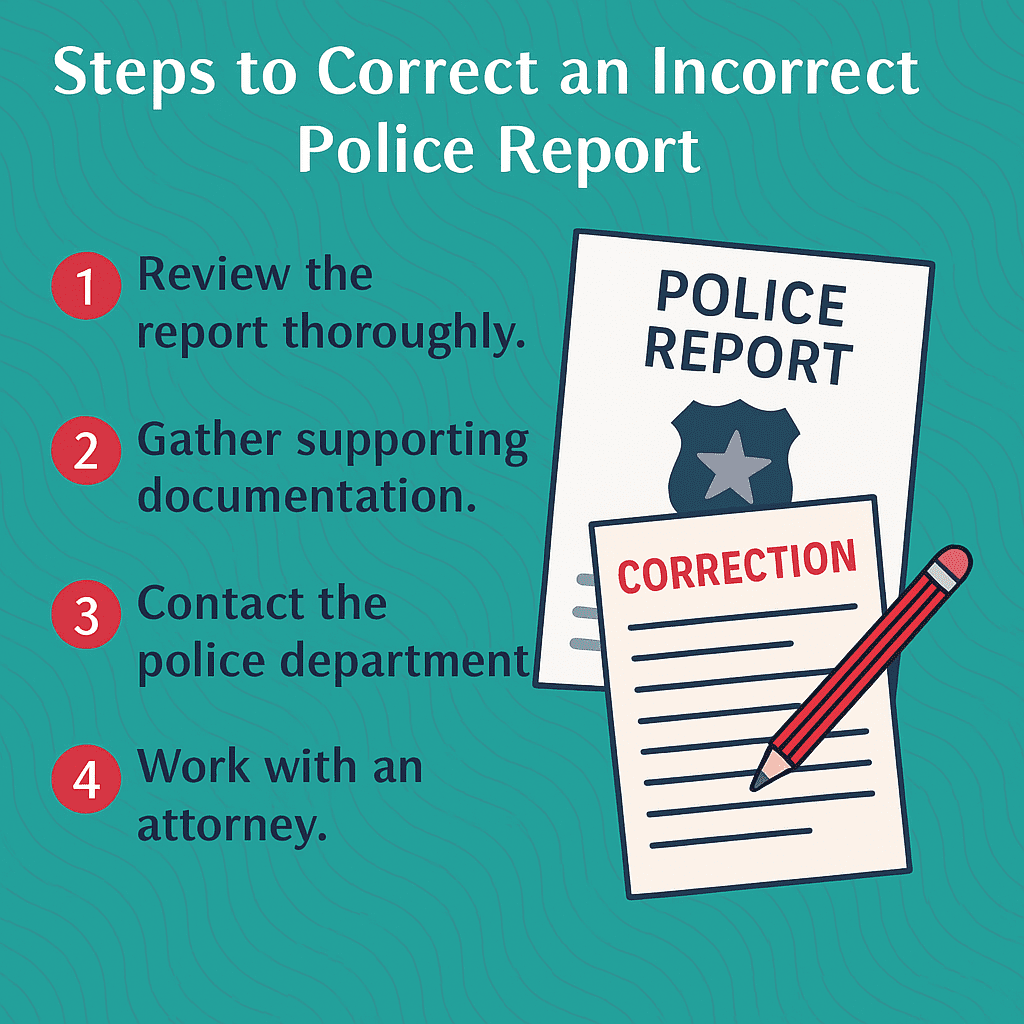
Step-by-Step: What to Do When Your Police Report Is Wrong
1. Obtain a Certified Copy of the Report
Your first move is to request the official document:
Contact the law enforcement agency that filed the report.
Request a certified copy from the records division.
In Texas, crash reports are often available via TxDOT’s CRIS (Crash Records Information System).
Ensure the copy includes officer details, filing date, and supplemental pages.
2. Review & Note Every Discrepancy
Print or highlight a digital copy. Make a side-by-side list of:
Wrong vs. correct names, addresses, vehicle details.
Incorrect times, dates, or locations.
Witness statements or quotes missing/misrepresented.
Injury descriptions or omissions.
Label each error as factual (easy to correct) or interpretive (harder to change).
3. Gather Strong Supporting Evidence
Corrections require proof. Collect:
Crash scene photos, videos, or dash cam footage.
Witness affidavits.
Medical reports showing injury timelines.
Vehicle registration, insurance, and repair records.
For example, if the report blames you in a semi-truck crash, your lawyer can compare it with settlement data like the average truck accident settlement in Texas.
4. Contact the Reporting Officer or Department
Be polite, professional, and persistent:
Call or email the officer or their supervisor.
Provide your documented corrections.
Focus on factual errors first — like VIN typos or license plate mistakes.
For disputed fault, know that officers often resist changing conclusions.
If the error involves alcohol, working with a Houston drunk driving accident lawyer may give your case more weight when disputing the officer’s version.
5. Submit a Supplemental or Amendment Request
If the original can’t be altered, request that a supplemental statement be attached:
Write a clear, factual account of corrections.
Attach supporting evidence.
Submit through the records division and keep copies.
Ask for written acknowledgment that your statement is part of the record.
6. Notify Insurance & Other Parties
Because insurers rely heavily on police reports:
Share your corrected version with your insurance company.
Send the same to the other party’s insurer if applicable.
Document that you notified them, so they can’t claim ignorance later.
7. Escalate or Challenge if Denied
If the department refuses to change the report:
File an appeal with the records division.
Escalate to the Chief or Internal Affairs.
Use your attorney to challenge in court.
Introduce stronger evidence like reconstruction experts or video footage.
This is often where having a lawyer helps. If settlement talks arise, see our guide on whether it’s better to settle your Texas car accident case outside of court.
8. Work With a Personal Injury Attorney
An attorney can:
Draft supplemental statements that won’t harm your case.
Negotiate directly with law enforcement or insurers.
Challenge inaccurate reports in litigation.
Cross-examine officers in depositions or trials.
If you’re a pedestrian injured in a crash, inaccuracies hit even harder. Learn about understanding your rights after a pedestrian accident in Houston.
Texas-Specific Nuances & Deadlines
Key local rules to remember:
Statute of Limitations: 2 years for personal injury claims.
Crash Records (TxDOT CRIS): available statewide.
Jurisdiction differences: policies for amendments vary by city/county.
Court use: Texas courts may consider police reports but allow challenges with better evidence.
Because time matters, hiring a car accident lawyer in Houston quickly gives you the best shot at corrections.
What to Do If the Report Is Never Changed
Even if the report remains unaltered:
Attach your supplemental statement.
Highlight inconsistencies in depositions.
Use experts to contradict false details.
Negotiate based on stronger evidence.
How to Use a Wrong Police Report in Court
Your attorney may:
Cross-examine the officer.
Admit your supplemental report.
Call reconstruction experts.
Show contradictions between the report and physical evidence.
Prevention Tips
Speak clearly and truthfully when giving your statement.
Mention all injuries, even minor ones.
Take your own photos.
Collect witness contacts.
Request supplemental reports if needed.
Frequently Asked Questions
Can you correct a police report in Texas?
Yes. You can usually correct factual mistakes, like names, license plates, or addresses, by contacting the reporting officer or police records division. For disputed issues, you may need to file a supplemental statement or work with an attorney.
How long do you have to fix a police report in Texas?
There is no strict deadline, but the sooner you request corrections, the better. Once insurance companies or courts start relying on the report, it becomes much harder to change.
Will a wrong police report hurt my insurance claim?
Yes. Insurance adjusters often rely heavily on the report when deciding liability. An error could reduce or delay your compensation unless corrected.
What if the officer refuses to change the report?
If your request is denied, you can file a supplemental statement, escalate to supervisors, or use your attorney to challenge the report in court.
Do I need a lawyer to dispute a police report?
Not always. You can attempt corrections yourself, but having a lawyer ensures your supplemental statement is legally sound and strengthens your chances if the issue escalates to court.
Can a judge disregard a police report in Texas?
Yes. Police reports are considered evidence but are not infallible. If contradicted by stronger evidence, courts may give them little weight.
Why The Texas Bulldog Is the Firm to Help
At the Miller Law Firm — home of The Texas Bulldog — we fight aggressively when inaccurate reports put our clients at risk. We know how to analyze and disprove flawed reports. We negotiate with insurance companies from a position of strength. We’ve secured life-changing results for our clients — see our case results. Google Reviews:
What Clients Say
⭐ ⭐ ⭐ ⭐ ⭐ “Thank you so much! Your kindness and patience with me when I was impatient, yes I had plenty of financial fears going into this. The relief that ALL my medical bills were paid and I still walked away with money made it all worth it! Erica and Julia were awesome! God bless you all” – Oneal T. ⭐ ⭐ ⭐ ⭐ ⭐ “I love him. He took very good care of me and I would recommend him to anybody who needs help.” – Cynthia N.
Contact The Texas Bulldog
A wrong police report doesn’t have to define your case. You can:
Request the official report.
Document errors.
Collect supporting evidence.
Submit corrections or supplements.
Notify insurance carriers.
Escalate if denied.
Work with a lawyer.
If your police report is wrong, don’t wait. Contact The Texas Bulldog today for a free consultation. See what past clients say about us on Google Reviews. Rated 4.9/5 by Houston Personal Injury Victims.
Visit Our Houston Office
The Miller Law Firm – The Texas Bulldog
4900 Woodway Drive Suite 900
Houston, TX 77056
☎️ 713-572-3333