One second you are walking. The next, your life changes.
You are on the ground. Pain hits fast. Sirens follow. Then come the medical bills, missed work, and calls from insurance companies that suddenly seem very interested in your story.
Here is the truth most people do not realize: insurance companies are not calling to help you. They are calling to protect themselves.
If you were hit by a car, working with a Houston pedestrian accident lawyer can make the difference between a low settlement and full compensation.
These cases are not simple. They involve serious injuries, disputed fault, and multiple insurance policies. If you do not understand how the system works, you are already at a disadvantage.
This guide breaks down how pedestrian accident cases actually work, how insurance companies try to reduce payouts, and what you can do to protect your case from day one.
Table of Contents
- Quick Answer
- Video: What To Do After Being Hit
- Why Pedestrian Cases Are Different
- Why These Cases Are Harder Than Car Accidents
- Common Pedestrian Accident Scenarios
- What To Do After an Accident
- Who Pays in a Pedestrian Accident?
- How Much Is a Pedestrian Injury Case Worth?
- What Evidence Helps Win a Case
- How Long Does a Case Take?
- Mistakes That Can Hurt Your Case
- Pedestrian vs Car Accident Claims
- How Insurance Companies Try to Pay Less
- Pedestrian Accident Statistics in Texas and Houston
- How Strong Cases Are Built and Why It Matters
- Why Hiring the Right Law Firm Matters
- When Should You Contact a Lawyer?
- Client Reviews
- Case Results
- Frequently Asked Questions
Quick Answer
A pedestrian injury law firm helps people hit by vehicles recover compensation for medical bills, lost wages, and pain and suffering. These cases often involve multiple insurance policies, and the final value depends on liability, injury severity, and available coverage.
Watch: What To Do After a Pedestrian Accident
If you were hit while walking, watch this video to understand what to do after a pedestrian accident and how to protect your claim.
Who pays after a pedestrian accident?
The at-fault driver’s insurance is usually responsible, but additional policies may apply depending on the situation.
Why Pedestrian Accident Cases Are Different
Not all injury cases are equal. Pedestrian accidents are in a completely different category.
When two cars collide, both drivers have protection. Seatbelts. Airbags. Steel frames. Even at high speeds, those protections reduce the force on the body.
Pedestrians have none of that.
When a vehicle hits a person, the human body absorbs the full impact. That is why these cases often involve:
- Traumatic brain injuries
- Spinal cord damage
- Multiple fractures
- Internal bleeding
- Permanent disability
But the injuries are only part of the problem.
The real fight starts after the accident.
Insurance companies do not look at these cases and think, “This person needs help.”
They look at them and think, “This could be expensive.”
When something looks expensive, insurance companies move fast to cut it down.
They question liability, challenge your injuries, and look for any angle to reduce what they pay.
If you are not prepared for that strategy, you will feel it immediately.
This is exactly why pedestrian accident claims are often more valuable, but also more aggressively challenged.
Why Pedestrian Accident Cases Are Harder Than Car Accidents
Most people assume pedestrian cases are easier. A car hit a person. That should be clear, right?
These cases are often harder than standard car accident claims.
That assumption is not always correct.
First, liability is not always as clear as it seems. Insurance companies will argue that you crossed outside of a crosswalk, that you were distracted, or that you stepped into traffic unexpectedly.
Even when a driver is clearly at fault, they will still try to shift part of the blame to you.
Second, the injuries are usually more severe. That increases the value of the case, but it also increases resistance from the insurance company. The more money on the line, the harder they fight.
Third, there is often less physical evidence compared to vehicle accidents. You do not always have skid marks, impact angles between vehicles, or multiple drivers telling their version of events.
That means your case has to be built differently. Strong evidence. Clear documentation. No gaps.
This is exactly where inexperienced representation falls apart.
Common Pedestrian Accident Scenarios
Not every pedestrian accident happens the same way. The details matter. They affect fault, insurance coverage, and case value.
Crosswalk accidents are the most straightforward on the surface. Drivers are required to yield to pedestrians in marked crosswalks. But even here, insurance companies will argue timing, visibility, and reaction.
Jaywalking cases are more complex. However, Texas follows modified comparative fault rules. That means you can still recover compensation even if you share some responsibility, as long as you are less than 51% at fault.
Parking lot accidents happen more often than people think. These cases involve slower speeds but unclear right-of-way. Drivers are expected to stay alert, but they often claim they never saw the pedestrian.
Hit-and-run accidents create a different problem. If the driver leaves the scene, you may need to rely on your own uninsured motorist coverage. Many people do not even know they have this protection.
Commercial vehicle accidents raise the stakes. If a company vehicle is involved, there may be higher insurance limits and additional liability. These cases require deeper investigation. These situations are similar to commercial truck accident cases, where multiple insurance policies may apply.
Every scenario changes how the case is handled. That is why cookie-cutter approaches do not work here.
What To Do After a Pedestrian Accident
If you were hit by a car, taking the right steps immediately can protect your health, your rights, and your case.
Taking the wrong steps after an accident can cost you. Here’s what to do to protect your case:
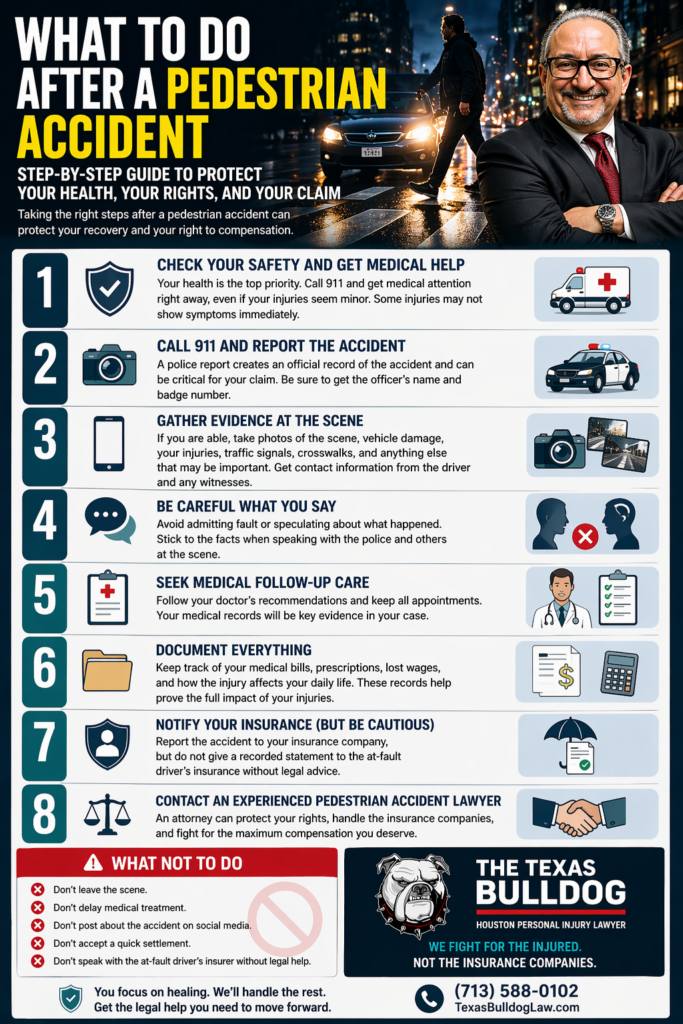
Insurance companies start building their case immediately. Taking these steps early helps protect your rights and puts you in a stronger position.
Following these steps can make a major difference in how your case is handled and how much compensation you may recover.
- Get medical care immediately. Your health comes first. It also creates a record of your injuries.
- Call the police. A police report is one of the most important pieces of evidence.
- Document the scene. Take photos. Record video. Capture vehicle positions, traffic signals, and surroundings.
- Get witness information. Independent witnesses can support your version of events.
- Do not talk to insurance companies alone. They are trained to ask questions that protect their side, not yours.
- Contact a pedestrian injury law firm. The sooner your case is handled correctly, the stronger it becomes.
Most people wait too long. They think they can handle it themselves. By the time they realize the insurance company is working against them, damage has already been done.
You do not get a second chance to build your case the right way.
Who Pays in a Pedestrian Accident?
This is one of the most misunderstood parts of these cases.
In serious cases, relying on a single insurance policy is often not enough to fully cover your damages.
Most people assume the driver’s insurance will simply pay. Sometimes that is true. Many times, it is not enough.
Pedestrian accident claims often involve multiple layers of coverage.
Here’s a simple breakdown of how pedestrian accident compensation works:
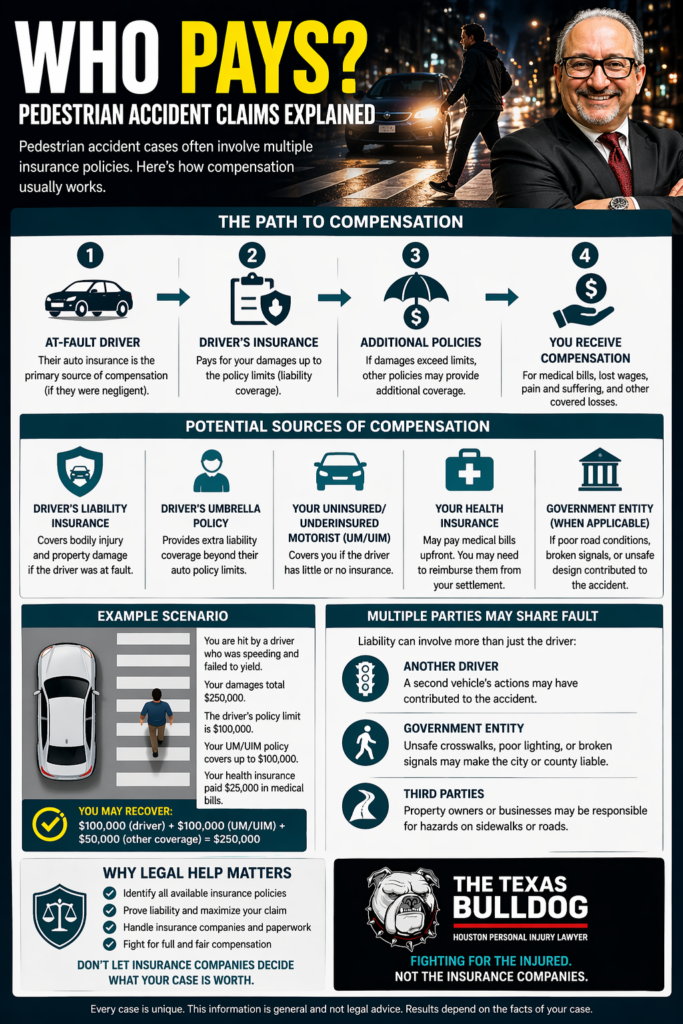
Because multiple insurance policies may apply, identifying every source of compensation is one of the most important parts of a pedestrian injury case.
First layer: the driver’s insurance.
If the driver is at fault, their liability policy should cover your damages. However, many drivers carry minimum policies that are not enough to cover serious injuries.
Second layer: your own insurance.
If the driver is uninsured or underinsured, your own policy may step in. This includes uninsured and underinsured motorist coverage.
Many people have this coverage and do not realize it.
Learn how this coverage works here
Third layer: additional liable parties.
This is where cases can expand significantly.
- Employers if the driver was working
- Bars or restaurants that overserved alcohol
- Property owners with unsafe conditions
- Government entities responsible for road design
Finding every available policy is one of the biggest factors in maximizing case value.
How Much Is a Pedestrian Injury Case Worth?
This is the question everyone asks, and the answer depends on how the case is built.
There are general ranges, but they only tell part of the story.
- Minor injuries: $15,000 – $50,000
- Moderate injuries: $50,000 – $250,000
- Severe injuries: $250,000 – $1,000,000+
What actually drives value?
Medical treatment. The more serious and documented the treatment, the stronger the case.
Lost income. Time away from work adds measurable damages.
Future impact. Long-term limitations increase value significantly.
Pain and suffering. This is often the largest portion of a claim, but also the most contested.
Liability clarity. The clearer it is that the driver is at fault, the stronger your negotiating position becomes.
Here is what most people miss: insurance companies do not just evaluate your injuries. They evaluate your lawyer.
If they believe your case is weak, they offer less. If they believe your case could go to trial, they increase the offer.
This is why representation matters.
These values are similar to high-value car accident cases involving serious injuries.
What Evidence Helps Win a Pedestrian Injury Case
Strong cases are built on strong evidence. Without it, the insurance company controls the narrative.
The most important evidence includes:
- Police reports: Establish initial fault and document the scene
- Traffic and surveillance footage: Often the most powerful proof
- Medical records: Show the extent and timing of injuries
- Witness statements: Provide independent support
- Expert analysis: Reconstructs how the accident happened
Timing matters here. Video footage can be erased. Witnesses can disappear. The sooner evidence is preserved, the stronger your position becomes. Without strong evidence, insurance companies control the narrative. With it, you control the leverage.
How Long Does a Pedestrian Injury Case Take?
Most cases do not resolve overnight. That is a good thing.
A typical case follows three phases.
Phase one: medical treatment. This can last weeks or months depending on the injury. You cannot fully value a case until treatment is complete or stable.
Phase two: negotiation. Once the damages are clear, the insurance company evaluates the claim and makes an offer.
Phase three: litigation. If the offer is not fair, the case may move into a lawsuit.
Some cases settle in a few months. Others take over a year.
Here is the key point: fast settlements are often low settlements.
Mistakes That Can Hurt Your Pedestrian Injury Claim
Insurance companies rely on mistakes. The more you make, the less they pay.
- Talking to insurance too early: They are trained to get statements that hurt your case
- Skipping medical treatment: Gaps in care reduce credibility
- Posting on social media: Your posts can be used against you
- Accepting the first offer: Initial offers are almost always low
These mistakes are avoidable, but once they happen, they are difficult to fix.
Pedestrian vs Car Accident Claims
| Factor | Pedestrian Case | Car Accident |
|---|---|---|
| Injury Severity | High | Moderate |
| Liability Disputes | Frequent | Less Common |
| Insurance Resistance | High | Medium |
| Case Complexity | High | Moderate |
Pedestrian cases are more complex. That complexity creates both risk and opportunity.
How Insurance Companies Try to Pay Less
Insurance companies move fast… to pay you less.
This is not a slogan. It is how the system works.
Common tactics include:
- Blaming the pedestrian for the accident
- Arguing that injuries are exaggerated
- Delaying the claim to create pressure
- Offering quick settlements before full damages are known
If you understand these tactics, you can avoid them. If you do not, you will feel them.
Why Pedestrian Accidents Are So Common in Houston and Texas
Pedestrian accidents are a growing problem across Texas, especially in large cities like Houston.
In Houston, busy corridors like I-45, I-10, Loop 610, and Beltway 8 create some of the highest-risk areas for pedestrian accidents. Heavy traffic, wide intersections, and high-speed roadways increase the risk for pedestrians every day.
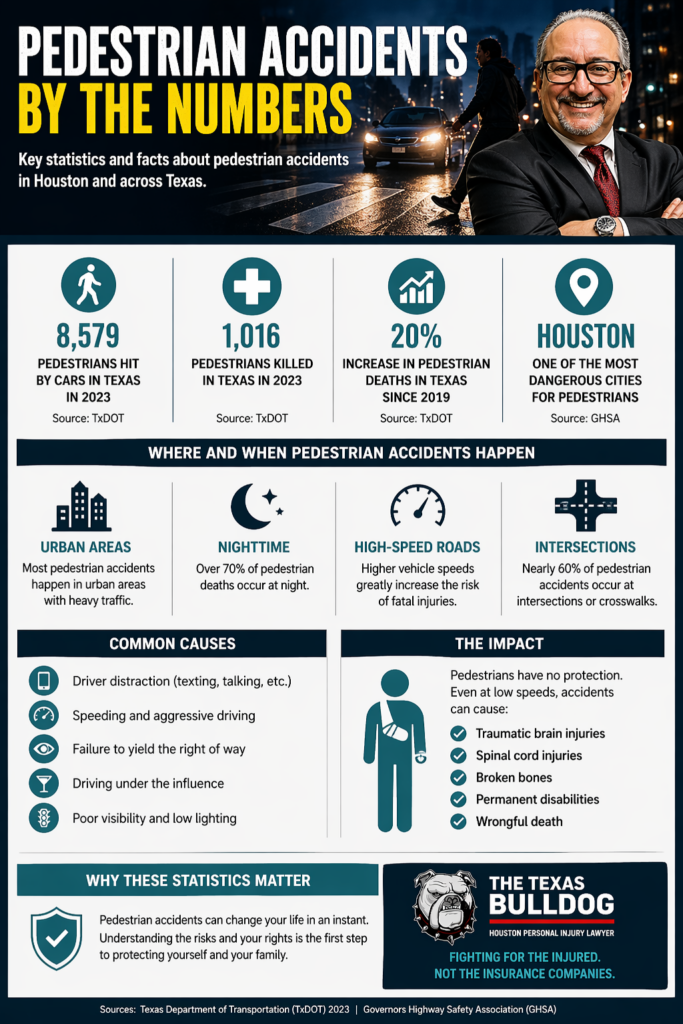
Many of these accidents happen in areas where drivers are not expecting foot traffic, or where visibility is limited.
- Urban areas account for the majority of pedestrian accidents
- Nighttime crashes are more likely to result in severe injuries
- High-speed corridors increase both impact force and injury severity
These factors are one reason pedestrian accident claims often involve significant damages and require careful case development.
How Strong Cases Are Built and Why It Matters
Not all injury cases are handled the same way. That is one of the biggest reasons settlement values vary so much.
Some law firms move cases quickly. They gather basic records, send a demand, and accept whatever the insurance company offers.
That approach may resolve a case fast, but it often leaves money on the table.
Stronger cases are built differently.
They focus on detailed evidence, clear documentation, and a strategy that shows the insurance company the case is ready for the next step if needed.
That changes how the claim is evaluated.
Insurance companies pay attention to risk. When a case is prepared the right way, that risk goes up, and so does the pressure to make a fair offer.
This is one of the biggest factors that separates low settlements from full compensation.
Why Hiring the Right Pedestrian Injury Law Firm Matters
At The Miller Law Firm, home of The Texas Bulldog, we do not treat cases like numbers.
We prepare every case as if it could go to trial. That changes how insurance companies evaluate the claim.
- Trial-ready case preparation
- Clear and consistent communication
- No upfront fees
- Local Houston experience
- Support with pre-settlement financial options
See what it’s like to work with our firm
Learn about financial support options

When Should You Contact a Pedestrian Injury Law Firm?
The earlier you involve a lawyer, the stronger your case becomes.
You should contact a pedestrian injury law firm:
- Before giving any recorded statement
- After any serious injury
- If fault is being disputed
- If the insurance company makes a quick offer
Early action protects your rights and preserves evidence. Waiting too long gives the insurance company a head start. Acting early puts you back in control.
Verified Client Reviews
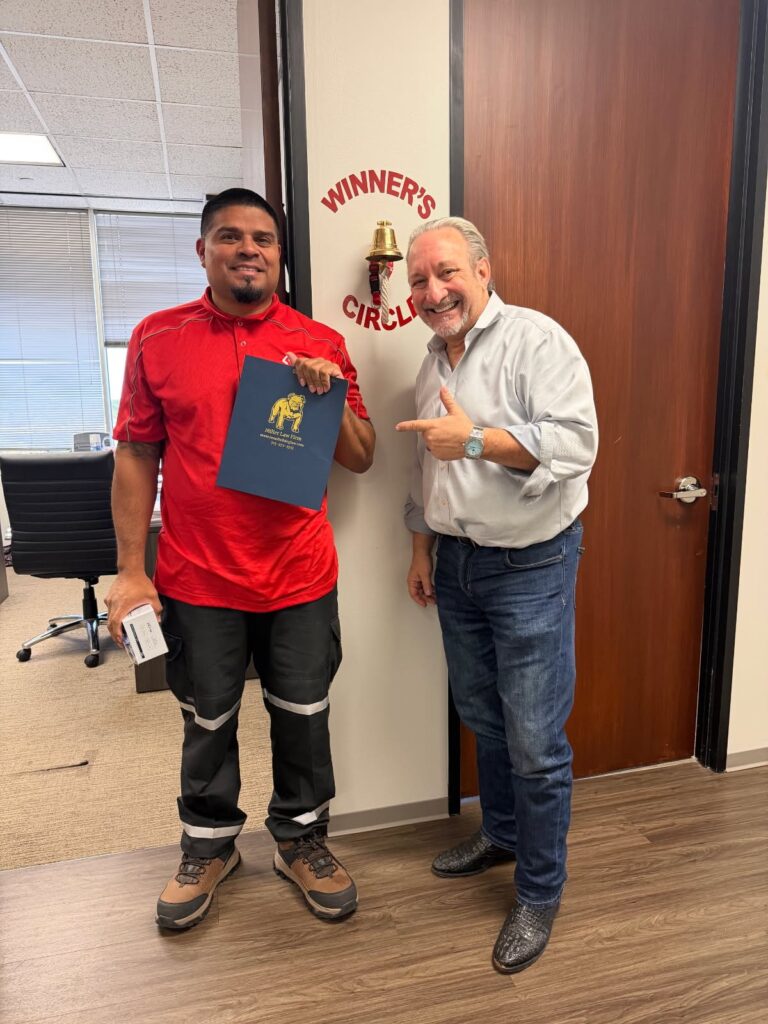
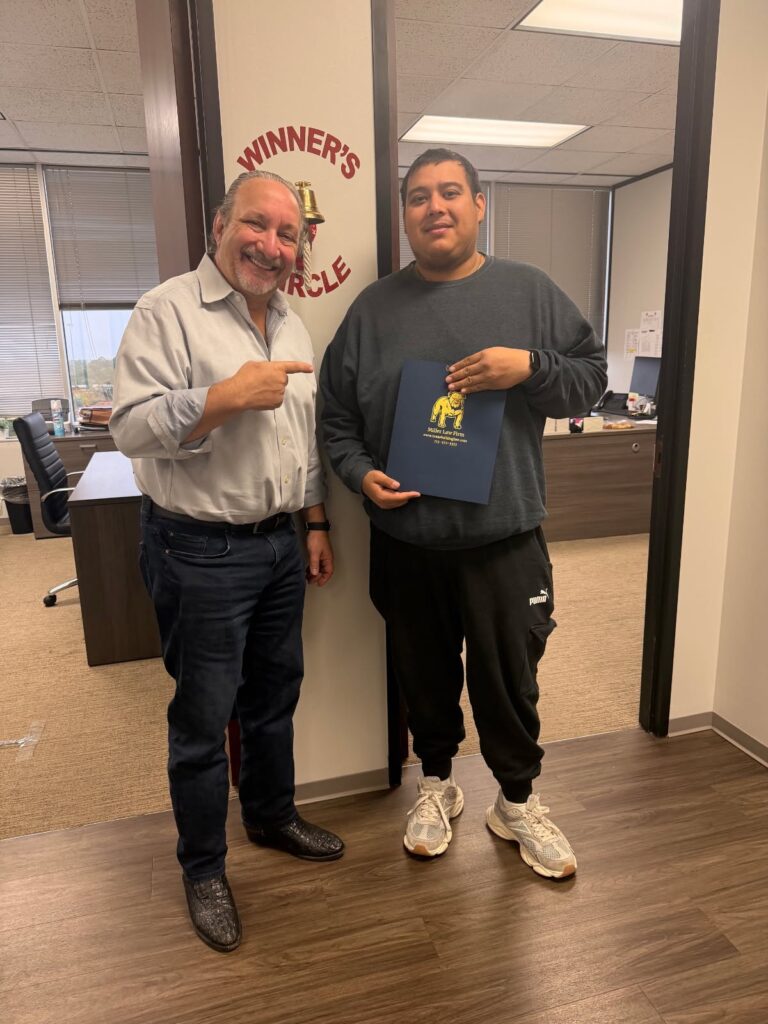
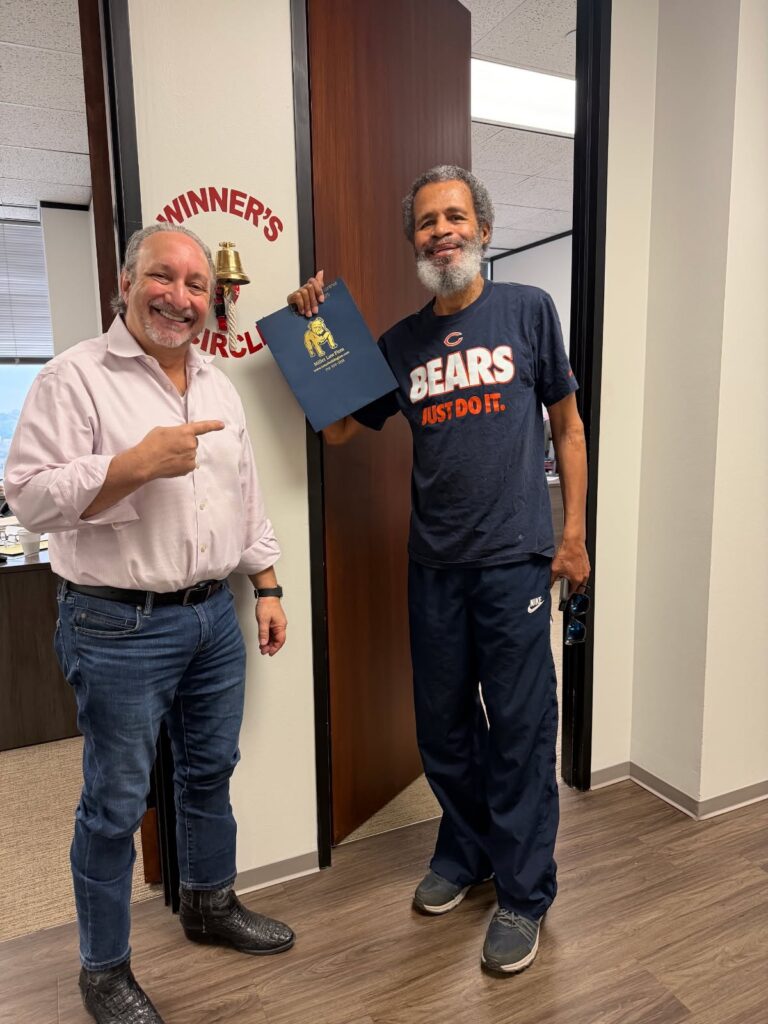
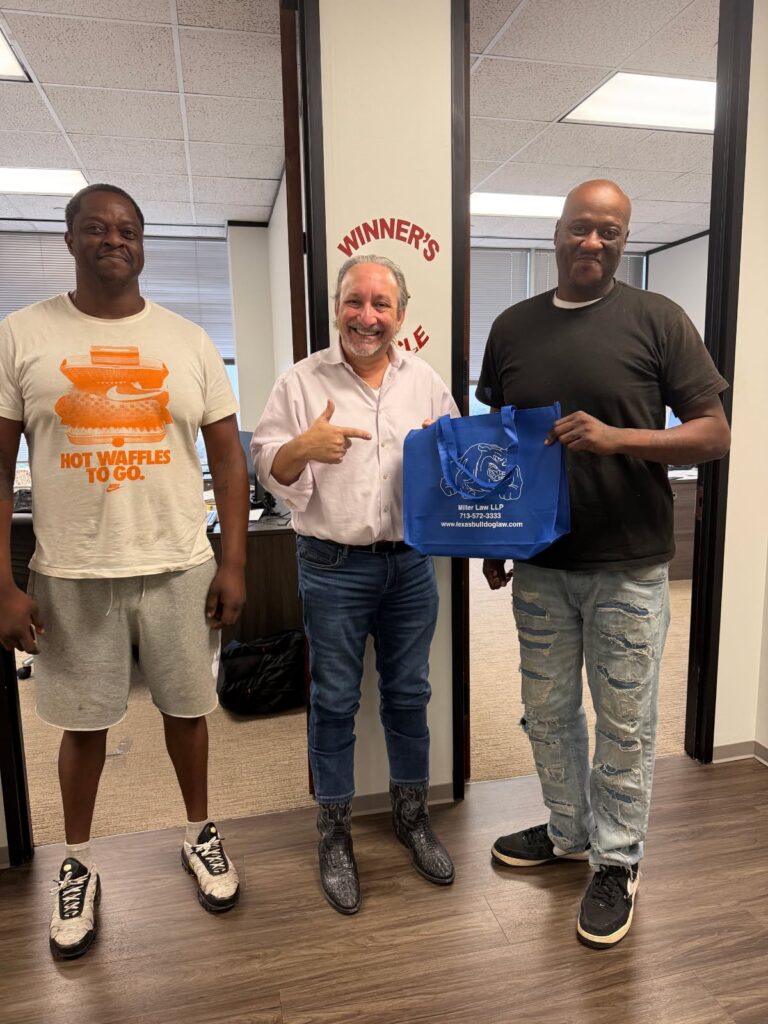
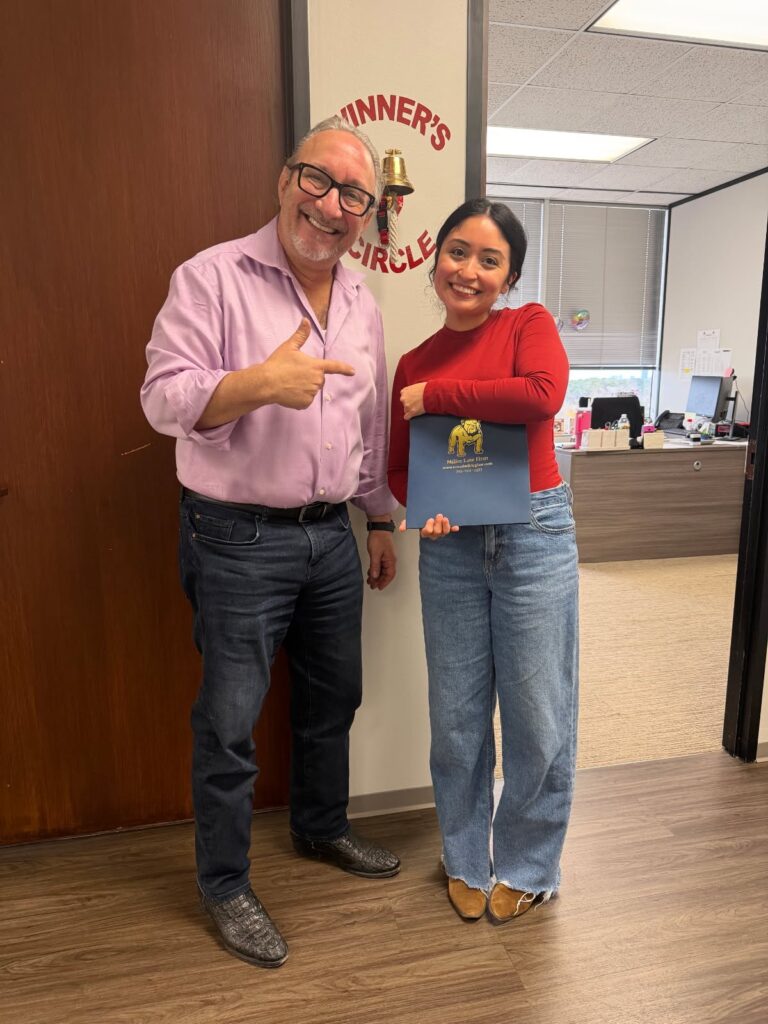
⭐⭐⭐⭐⭐ “Very happy with their work. I would highly recommend this law firm. They made the process easy and stress free.” – Ivan S.
⭐⭐⭐⭐⭐ “Miller was great! Helped me win my case 😁😁 i definitely recommend” – Tiffany M.
⭐⭐⭐⭐⭐ “I cannot thank The Miller Law Firm enough for taking my case when no one else would. I came to them last minute, overwhelmed and unsure of what to do, and they stepped in without hesitation.
From the beginning, they treated me with respect, patience, and professionalism. They took the time to understand my situation and fought for me when I truly needed someone in my corner. That meant more to me than I can put into words.
What stood out the most was their willingness to take a chance on me when other firms would not. That kind of dedication and belief in a client is rare.
Thank you again for your hard work, your support, and for helping me get through a very difficult situation. I’m truly grateful.” – Robin
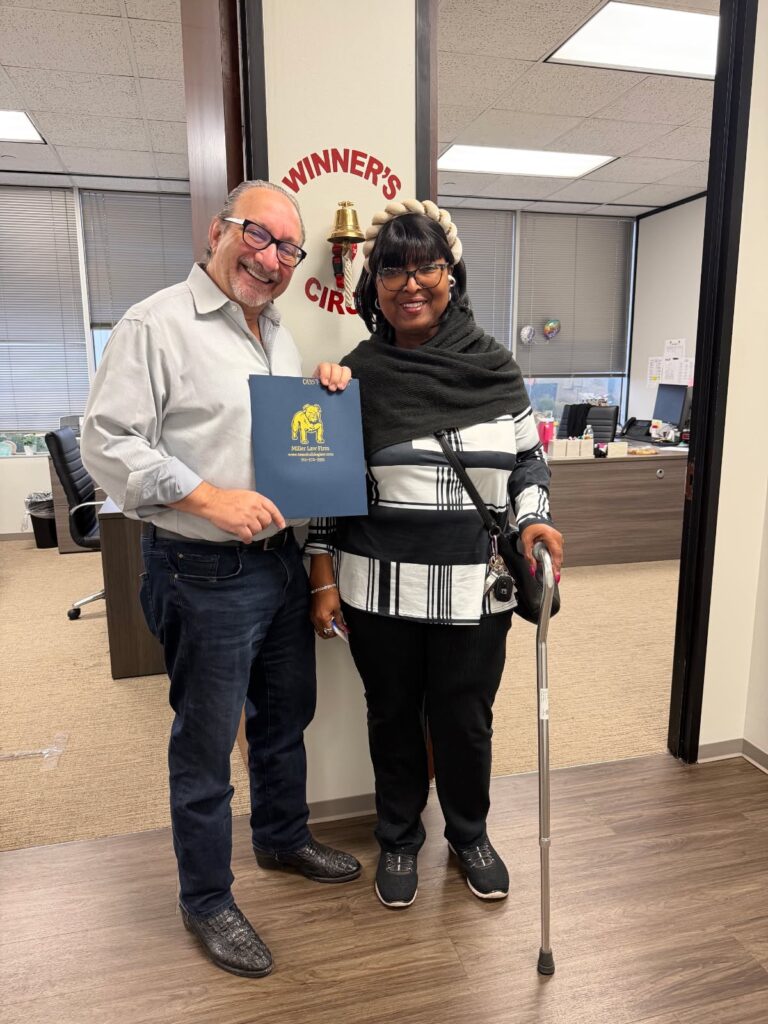
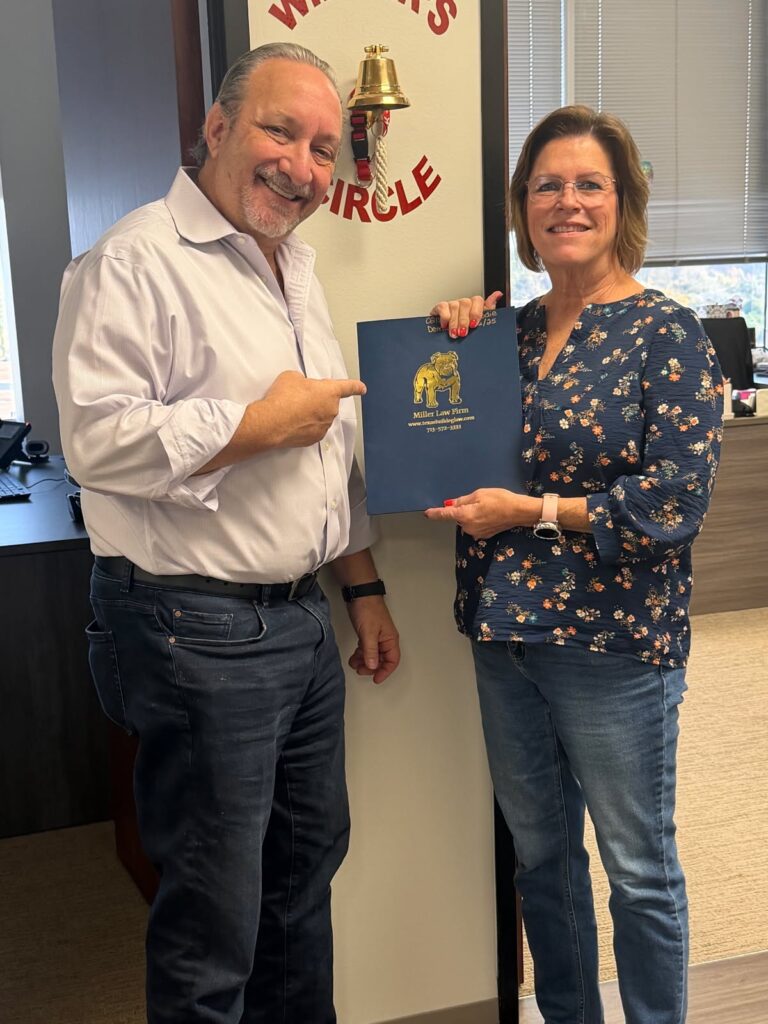
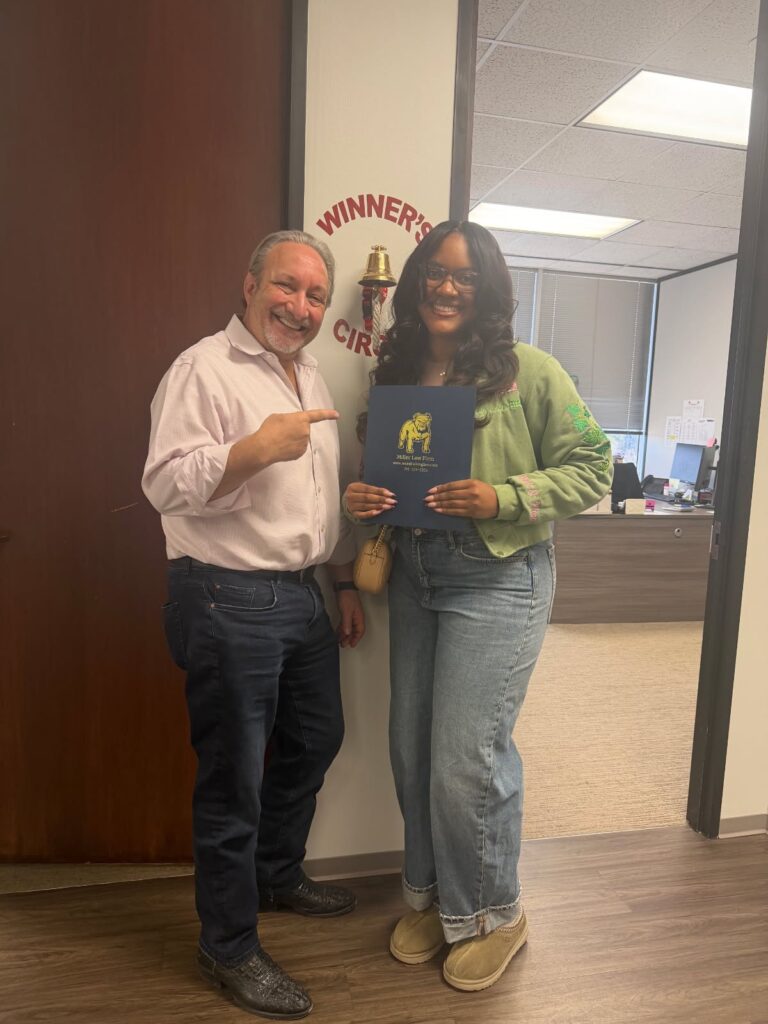
Case Results
- Six-figure pedestrian accident settlement in a case where liability was heavily disputed
- Strong recovery for a client struck in a crosswalk after the insurance company denied responsibility
- High-value settlement involving a commercial vehicle and multiple insurance policies
Every case is different, but results often depend on how aggressively the case is prepared and presented.
Frequently Asked Questions
What damages can I recover?
Medical bills, lost wages, pain and suffering, and future care costs.
Can I still recover if I was partially at fault?
Yes, as long as you are less than 51% responsible.
What if the driver fled the scene?
You may still recover through uninsured motorist coverage.
How is fault determined?
Through evidence such as reports, witness statements, and video footage.
Do I need a lawyer?
Yes, especially for serious injuries or disputed liability.
How long do I have to file a claim?
Most cases must be filed within two years in Texas.
Can I sue a company if their driver hit me?
Yes, if the driver was acting within the scope of employment.
What if my claim is denied?
You may still pursue compensation through negotiation or litigation.
What if I was hit in a parking lot?
You may still have a valid claim depending on the circumstances.
How much does it cost to hire a lawyer?
Most pedestrian injury law firms work on a contingency fee basis with no upfront cost.